
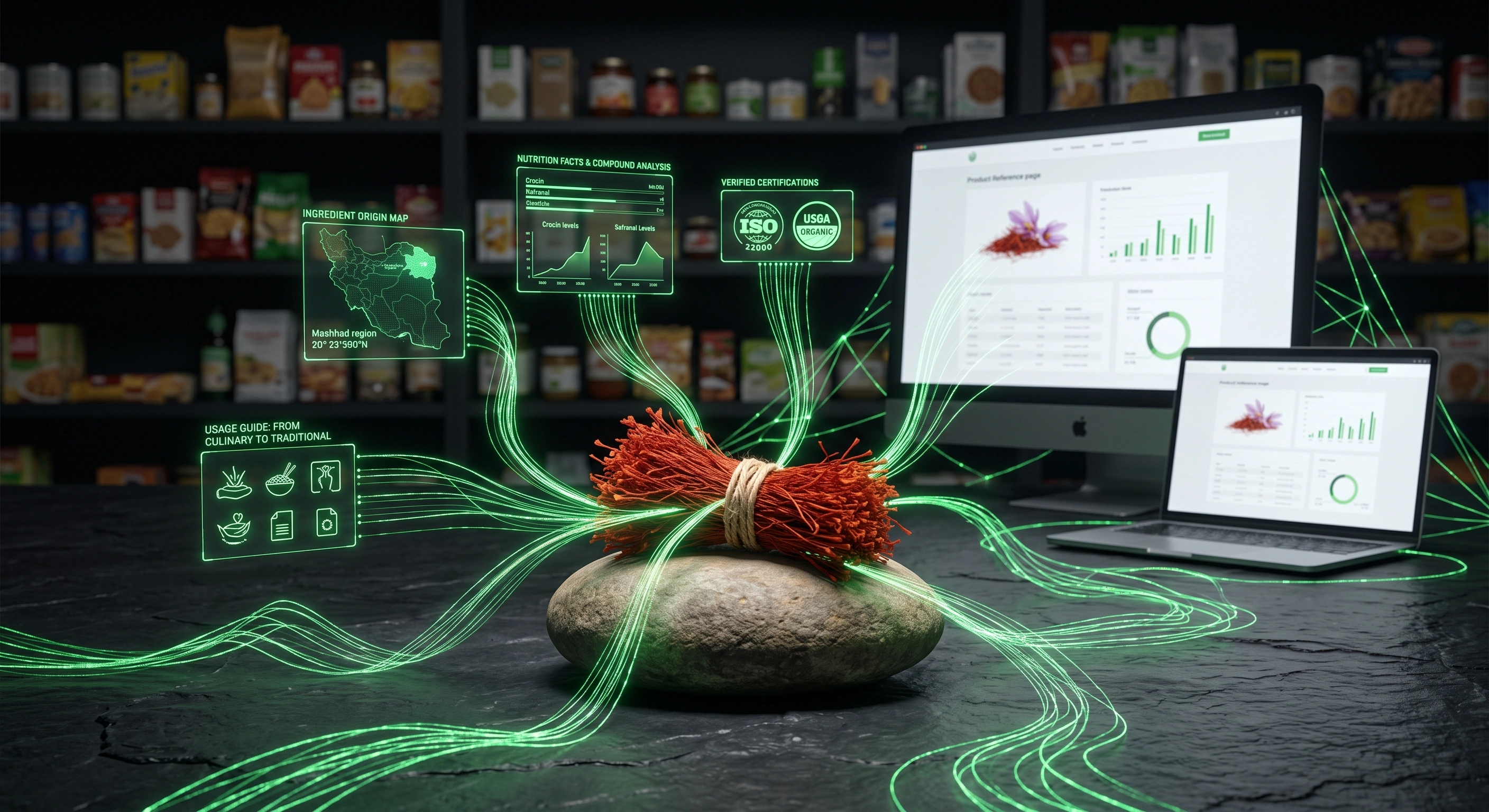
Imagine a customer wants to learn more about one of your products.
The package has limited space, so they search the product name and arrive on the brand’s official website.
What do they find?
Perhaps a polished product image and two lines of marketing copy.
To check the ingredients, they go to an online retailer.
To find the nutrition panel, they search Google Images for the back of the pack.
To verify a certification, they open another website.
To understand the difference between two products, they search the brand’s social media history.
And after all of that, they still cannot be certain which information is current.
In this situation, the company has a website.
But it does not yet have an authoritative digital source for its own brand and products.
That distinction matters.
A strong food brand website should not simply tell visitors:
“This is who we are, and this is what our products look like.”
It should become the place customers, retailers, distributors, business partners and other audiences can return to when they need reliable answers about:
- products,
- ingredients,
- nutrition,
- certifications,
- usage,
- availability,
- company information,
- or ways to contact the brand.
In other words:
When someone needs the official, current version of the information, the brand itself should provide the best answer.
This has become increasingly important as trust becomes a more valuable part of the consumer relationship.
NielsenIQ’s Consumer Outlook: Guide to 2026 reports that 95% of consumers say trusting the brand they buy from is either very or somewhat important. Product quality and consistency are among the strongest foundations of that trust, while responsiveness from the brand also plays a significant role.
Accurate and accessible product information is therefore not merely a technical website requirement.
It is part of how a food brand earns trust.
1- Having a Website Is Not the Same as Being the Official Source
Not every company website functions as a genuine reference point.
A website may be beautifully designed but contain very little useful information.
It may have dozens of pages but leave visitors unsure which details are still current.
It may mention the product portfolio while retailers provide more complete product descriptions than the brand itself.
Or it may be filled with promotional copy without answering the practical questions shoppers actually have.
When we describe a food brand website as an official source, we mean it should meet three fundamental conditions.
The information should be clear
Visitors should not need to search across multiple pages to find basic answers.
The information should be sufficiently complete
For important questions, customers should not be forced to rely on unofficial third parties.
The information should be current and dependable
When packaging, formulations, certifications, contact details or product availability change, the website should change with them.
These principles sound simple.
But delivering them consistently requires a shift in mindset.
The website can no longer be treated only as a design project.
It needs to be treated as a living information system for the brand.
2- Why This Matters More for Food Brands
For many consumer goods, the customer may need only a relatively small set of specifications.
Food products create a much wider range of questions.
A shopper may want to know:
- Does it contain gluten?
- How much sugar does it contain?
- Does it contain nuts or other allergens?
- What is the protein source?
- Is it suitable for children?
- Is it plant-based?
- How should it be stored?
- Is the organic claim certified?
- How should it be prepared?
- Where do the ingredients come from?
- Is the new package in the store still the same formulation?
Different shoppers may need entirely different answers.
This is particularly important for consumers managing allergies or other dietary requirements.
NielsenIQ’s 2026 work on allergen-aware shoppers highlights how many consumers still face a complex and confusing experience when trying to determine whether products are appropriate for them, and how clearer allergen information can support more confident purchasing decisions.
Trust is also an issue around health positioning.
In its 2026 health and wellness analysis, NielsenIQ reported that 62% of surveyed consumers said they do not trust health claims made by food companies.
That means phrases such as:
“healthy,”
“natural,”
“clean,”
“high-protein,”
or “better for you”
cannot do all the work on their own.
Consumers increasingly ask:
“Why should I believe this claim?”
The official website is one of the places where a brand can reduce the distance between the claim and the evidence behind it.
3- The Package Is the Beginning of Product Information, Not the End
Food packaging has a fundamental limitation:
space.
A relatively small surface may need to contain:
- the brand name,
- product name,
- legal information,
- ingredients,
- nutrition facts,
- net weight,
- barcodes,
- storage requirements,
- claims,
- instructions,
- and sometimes multiple languages.
It is impossible to communicate everything a customer might want to know on the physical package.
Digital channels do not have the same limitation.
The website can extend what begins on the pack.
For example, if the package says:
“High in protein,”
the website can explain:
- How much protein?
- Per serving or per 100 grams?
- What is the protein source?
- What criteria support the claim?
- Who might find the product relevant?
If the pack makes a claim about ingredient origin, the site can explain where those ingredients come from and how they are sourced.
If a certification exists, the website can identify the certification, the issuing organisation and the scope of what has actually been certified.
If the product requires preparation, the site can provide instructions, photographs or video.
NielsenIQ Brandbank has previously reported that many shoppers want access to more information than can fit on the physical label, including details about allergens, certifications, lifestyle attributes and other product characteristics.
The website should therefore not simply reproduce the package at a larger scale.
It should provide the next layer of product knowledge.
4- Every Important Product Needs a Reference Page
One of the foundations of an authoritative food brand website is a dedicated page for each important product.
Not a page created purely to target a keyword.
Not just an image in a product gallery.
A genuine product reference page.
Depending on the category, that page may include:
- Official product name
- Category and subcategory
- Variant or flavour
- Available sizes
- Current packaging imagery
- Clear product description
- Ingredients
- Nutrition information
- Allergen information
- Preparation or serving guidance
- Storage requirements
- Certifications
- Verifiable claims
- Country or region of production
- Related products
- Frequently asked questions
- Where to buy
and, where relevant:
Technical information for trade buyers
Not every product needs every field.
A saffron pack, a protein beverage and a frozen meal have very different information requirements.
The principle is more important than the template:
The product page should be designed around the real questions people ask about that particular product.
A fixed page structure copied across the entire portfolio is useful only if it still reflects those differences.
5- Product Information Should Exist as Data, Not Only as Copy
This is slightly more technical, but it has major implications for how a food brand can grow digitally.
Suppose product weight appears only in a sentence:
“Available in a 400 g pack.”
A person can understand that immediately.
But if the product information is stored in a structured way, the system can understand something like:
- Product name: X
- Net weight: 400 g
- Flavour: Chocolate
- Category: Snack
- Allergen: Milk
- Packaging type: Pouch
- Product identifier: …
That difference matters.
Because the same product information can then support:
- the website,
- product filters,
- e-commerce,
- mobile applications,
- catalogues,
- retailer feeds,
- internal systems,
- and eventually AI-powered tools.
The global consumer-goods industry already operates on this principle.
GS1 is the international standards organisation behind widely used systems for product identification and data exchange, including the family of standards associated with common product identifiers and barcodes.
Its Global Data Synchronisation Network, or GDSN, allows brand owners and trading partners to synchronise core product information so that retailers and other parties can work from current and consistent data.
A smaller food business does not need to implement an enterprise-scale data network from day one.
But the principle is valuable at any scale:
Product information should not be recreated manually in ten different places.
There should be an approved master version from which other channels are supplied.
6- Separate Official Product Facts From Marketing Language
This distinction matters enormously.
Compare these two statements:
“A wonderfully healthy way to start an energetic day.”
and:
“Contains 20 g of protein per serving.”
The first is marketing language.
The second is a measurable product attribute.
Both may have a legitimate role on the website.
But they are not the same type of information.
An authoritative food website should distinguish between:
product facts,
brand claims,
and
educational or promotional content.
This matters particularly when dealing with claims around:
- health,
- nutrition,
- sustainability,
- organic certification,
- origin,
- sugar-free formulations,
- gluten-free products,
- natural ingredients,
- and many other food attributes.
Depending on the market, such claims may have legal definitions or require supporting evidence.
An authoritative website does not eliminate marketing.
It ensures that:
marketing does not replace information that should be verifiable.
7- Important Claims Should Have an Evidence Trail
Suppose the website says:
“Sustainably sourced ingredients.”
A customer may reasonably ask:
What does “sustainably sourced” mean here?
Which ingredients?
Against which standard?
Has an independent organisation verified the claim?
Or is this the company’s own definition?
The same applies to statements such as:
- organic,
- preservative-free,
- high-protein,
- locally sourced,
- responsibly farmed,
- recyclable,
- certified.
NielsenIQ has used the concept of a growing “credibility economy” to describe a market in which consumers increasingly want brands to substantiate what they say.
For websites, the implication is practical.
Important claims should, where appropriate, connect to something more concrete:
a certification,
a recognised standard,
an explanation of methodology,
a data source,
supporting documentation,
or a clear statement defining what the claim actually covers.
A product page does not need to read like a scientific paper.
But a shopper should be able to understand:
“What is this claim based on?”
That ability can make a significant difference to trust.
8- Explain Products in the Language of Customer Needs
Companies often organise products according to internal logic.
For example:
- X200 Range
- Premium Series
- Production Line 3
- Wellness Portfolio
Those labels may make sense inside the business.
They may not match how customers search.
A shopper is more likely to ask:
“Which product is lactose-free?”
“Which one is better for cooking?”
“Which coffee is less bitter?”
“Which pack is better for a family?”
“Do you have anything without nuts?”
“Which product needs refrigeration?”
This is where the website can evolve from a product catalogue into an answer-finding tool.
NielsenIQ’s work on the digital shelf in 2026 highlights the importance of complete product information, clear attributes, strong imagery, certifications and structured product content in digital discovery and shopper confidence.
So products do not always need to be discoverable only through their official names or corporate category structures.
Where relevant, a site might also allow visitors to browse or filter by:
- ingredients,
- dietary needs,
- flavour,
- usage occasion,
- pack size,
- product attributes,
or other criteria that reflect how people actually choose.
This is where product knowledge becomes digital experience.
9- Food Brands Should Teach, Not Just List Products
Being an authoritative source does not mean publishing product specifications alone.
Consider an olive-oil brand.
Customers may want to know:
What is the difference between extra virgin and regular olive oil?
Can this product be used for cooking?
How should olive oil be stored?
Why does harvest date matter?
Or a coffee brand:
What does roast level mean?
Which brewing method suits this product?
Or a dried-fruit brand:
How should the product be stored for freshness?
What is the difference between varieties?
This is where the website can move beyond being a catalogue and become a knowledge resource around the product category.
But there is an important condition.
The brand should not publish articles simply to increase page count.
Each piece of content should answer a genuine customer question.
The strongest structure connects:
product pages with relevant educational content.
An olive-oil page might link to an article on correct storage.
That article can then guide readers towards relevant products.
The result is not a random collection of blog posts.
It becomes a connected knowledge system.
This is far more useful for customers — and far more strategically valuable for the brand.
10- Basic Brand Facts Should Have One Consistent Answer
Consider a company that says on its About page that it was founded in 1996.
The English page says 1998.
An export profile lists another date.
The Contact page displays one address, while the footer still contains the previous office location.
These inconsistencies are more common than they should be.
For an authoritative website, the core facts of the organisation need to be controlled.
That may include:
- official brand name,
- company name,
- founding date,
- logo,
- short company description,
- addresses,
- contact details,
- markets served,
- certifications,
and relationships between parent companies and consumer brands.
Google also provides Organization structured data, a standard way of marking up core organisational information so search systems can better identify the entity behind a website.
That can include details such as:
name,
logo,
address,
and other organisational identifiers.
The purpose is not to organise the business around Google.
The sequence should be the other way around:
First establish the truth of the brand. Then publish that truth clearly for both people and digital systems.
11- An Authoritative Website Needs Version Control
This is particularly important in food.
Products change.
Formulations may be adjusted.
Packaging may be redesigned.
A new pack size may launch.
Certifications expire or renew.
Markets change.
Products are discontinued.
Claims are added or removed.
If the website continues displaying the old version, it is no longer functioning as a reliable source.
That means the organisation needs internal answers to questions such as:
- Who owns product information?
- How often is it reviewed?
- Who updates the website when packaging changes?
- What happens when a product is discontinued?
- How are market-specific versions managed?
- Who verifies changes in nutrition information?
- When should old imagery be removed?
These processes are mostly invisible to website visitors.
But they are among the most important differences between a functioning digital reference system and a one-time website project.
Authority is not primarily a visual characteristic.
It is an information-maintenance discipline.
12- One Product Page May Not Be Enough Across Different Markets
This becomes particularly important for exporting food brands.
The “same” product may differ across countries in:
- packaging,
- pack size,
- language,
- ingredients,
- nutrition labelling,
- certifications,
- commercial name,
- or even formulation.
If all of those versions are presented on one page without context, confusion follows.
A strong international site should make it clear:
Which market is this information for?
Which package does this image represent?
Which ingredients apply to this country?
Is the product currently sold in that market?
For international brands, the website therefore needs to consider both market and product version.
This is not only an export problem.
Even within one country, older packaging may remain in stores while a new design is already being distributed.
A reliable reference system should acknowledge this complexity rather than pretend it does not exist.
13- The Company Needs an Internal Source of Truth Too
A trustworthy website cannot exist if the company itself has no agreed source for product information.
Imagine this structure:
- the website team uses a spreadsheet from sales;
- the online store uses an old catalogue;
- the social media team types details from the physical package;
- the export department maintains its own document;
- the design team has another file entirely.
- Eventually, those versions will conflict.
The company needs to answer one fundamental question:
Where does the approved version of product information live?
For a smaller business, the answer does not need to be sophisticated.
It may begin with a carefully managed database or controlled internal system.
But it should be clear:
which information is approved,
who owns it,
when it was last changed,
and where it should be used.
Larger companies often manage this through Product Information Management, or PIM, systems.
A smaller brand does not necessarily need a complex PIM platform immediately.
The principle matters more:
One truth — not several disconnected versions of the truth.
Once that principle exists internally, creating a more reliable website becomes much easier.
14- Becoming AI-Readable Starts With the Same Fundamentals
Brands increasingly ask how they can make their products easier for AI systems to understand.
It is tempting to assume this requires an entirely new set of tactics.
The foundations are much more familiar.
Information needs to be:
- clear,
- structured,
- accurate,
- accessible,
- current,
- and reasonably consistent.
NielsenIQ’s 2026 health and wellness analysis notes the growing importance of accurate, structured and attribute-rich product data as consumers increasingly use AI-supported discovery and recommendation tools.
These systems need enough information to understand the differences between products and match them against increasingly specific customer needs.
Google has also stated in its guidance for AI-powered search experiences that brands do not need a separate hidden optimisation system or special AI-only markup.
The established fundamentals remain important:
useful content,
accessible pages,
clear information,
strong technical search foundations,
and structured data that accurately reflects what users can see on the page.
So the goal is not to write the website for AI.
The goal is:
to describe the brand and its products so clearly that both people and machines can understand them correctly.
That is a healthier long-term strategy than chasing temporary optimisation tricks.
15- Authority Needs to Be Consistent From the Homepage to the Smallest Product Detail
Trust is rarely created by a single statement such as:
“Over 30 years of experience.”
It is built through many smaller signals.
A product page with current photography.
Ingredients presented clearly.
A claim supported by evidence.
A certification that can be verified.
A contact number that works.
Consistent information across English and local-language pages.
An article that genuinely teaches something useful.
A website that changes when the product changes.
All of these small details reinforce one larger idea:
the brand is paying attention to the accuracy of what it tells people.
That aligns with NielsenIQ’s findings around trust in consumer goods, where product performance, consistency, transparency and responsiveness continue to influence brand credibility.
For a food company, the official website can become one of the most important places where that credibility is demonstrated rather than merely claimed.
A Practical Information Architecture for an Authoritative Food Brand Website
There is no universal website structure for every food company.
But a useful framework may include the following layers.
1- Brand Identity
Who are we?
What do we make?
Which company owns the brand?
Which markets do we serve?
2- Product Portfolio
How are product categories organised?
Can visitors find the right product easily?
Is search or comparison useful?
3- Product Reference Pages
One dependable location for the current information about each important product.
4- Evidence and Verification
Certifications, standards, verifiable claims and other supporting information.
5- Product Knowledge
Guides, articles, FAQs, usage instructions and educational content.
6- Where to Buy
What should the customer do after becoming interested?
7- Contact Routes
Where should consumers, wholesalers, distributors, export buyers and media enquiries go?
8- Corporate and Trade Information
What do professional buyers, partners and other business audiences need?
9- Structured Information
Can search engines and other digital systems clearly interpret the organisation and product data?
10- Information Governance
Who is responsible for keeping all of this current?
This last layer is easy to overlook.
Without it, the previous nine eventually become outdated.
The “Official Source” Test
There is a useful way to evaluate whether your website really functions as an authoritative brand resource.
Imagine that tomorrow all of your:
brochures,
sales files,
social media posts,
WhatsApp messages,
retailer explanations,
and product presentations
disappeared.
Only the official website remained.
Could someone understand:
- Who the company is?
- Which products it offers?
- What each product actually is?
- What ingredients it contains?
- Which claims are supported?
- How it should be used?
- Where it can be purchased?
- Who to contact with a question?
- Which information relates to the current version?
- Would a retailer, journalist or potential business partner find what they need?
If the answer to many of these questions is no, the site is still functioning more as a showcase than a reference source.
Food Brand Website Authority Checklist
Before redesigning or expanding a food brand website, ask:
- Does every important product have one official and unique page?
- Does product information come from an approved internal source?
- Are ingredients, nutrition, allergens and storage information clear where relevant?
- Do important claims have evidence or supporting explanation?
- Do the images represent packaging currently available in the market?
- Are market-specific versions of products clearly distinguished?
- Do customers need to leave the official website to find essential product information?
- Can products be found according to real customer needs, not only internal company categories?
- Are educational articles connected to relevant products?
- Are official company details consistent across the website?
- Are product and organisation details also available in appropriate structured formats?
- Is there a defined review process for important information?
- Is ownership of each information category clear inside the company?
- When a product changes, is there a process for updating the website?
- Can a first-time visitor answer most basic questions without needing to contact the company?
When most of these questions have clear answers, the website begins to move beyond being a design output.
It becomes a real brand asset.
Being the Official Source Means Being the Best Source About Yourself
No food brand can control everything that is said about it online.
Retailers will create their own product descriptions.
Consumers will publish reviews.
Media organisations will write stories.
AI systems will combine information from multiple sources.
The goal should not be to control every voice.
A more realistic goal is:
When someone wants the official, complete and current version of the information, the brand should provide the strongest answer.
That is what separates an authoritative website from a digital brochure.
A brochure says:
“Here is what we want to tell you about ourselves.”
A reference source asks:
“What does our audience need to know in order to understand us and our products correctly?”
For food brands, that distinction is especially important.
The product will be eaten.
Drunk.
Served to families.
Evaluated against dietary preferences.
Compared for health, ingredients and quality.
Purchased repeatedly.
In that relationship, information is not a decorative layer around the product.
It is part of the product experience.
So perhaps the final question for evaluating a food brand website should not be:
“How good does our website look?”
A more meaningful question is:
“If there could be only one official source online about our brand and products, would we want this website to be that source?”
If the answer is yes, the site is no longer just a showcase.
It has become part of the brand’s infrastructure for trust, knowledge and long-term growth.
Sources
- NielsenIQ — Consumer Outlook: Guide to 2026.
- Referenced for consumer trust in brands and the role of product quality, consistency and responsiveness in building that trust.
- NielsenIQ — From Risk to Reward: Trust, Choice, and Growth in an Allergen-Aware Market, 2026.
- Referenced for the importance of clearer allergen information and the challenges faced by allergen-aware consumers.
- NielsenIQ — Health and Wellness Consumer Trends 2026.
- Referenced for consumer scepticism towards some food health claims and the growing importance of accurate, structured and attribute-rich product data.
- NielsenIQ — The Credibility Economy: How Trust Is Reshaping FMCG Growth, 2026.
- Referenced for the growing importance of verifiable claims, substantiation and credibility in consumer packaged goods.
- NielsenIQ — The Digital Shelf: The Anchor of Omnichannel Success in 2026.
- Referenced for the role of complete product information, imagery, certifications and structured attributes in digital discovery and shopper confidence.
- NielsenIQ Brandbank — Do Shoppers Trust Your Product Information? Why Brands Need to Go Beyond the Label.
- Referenced for consumer demand for product information beyond what can fit on the physical package.
- GS1 — Global Data Synchronisation Network (GDSN).