
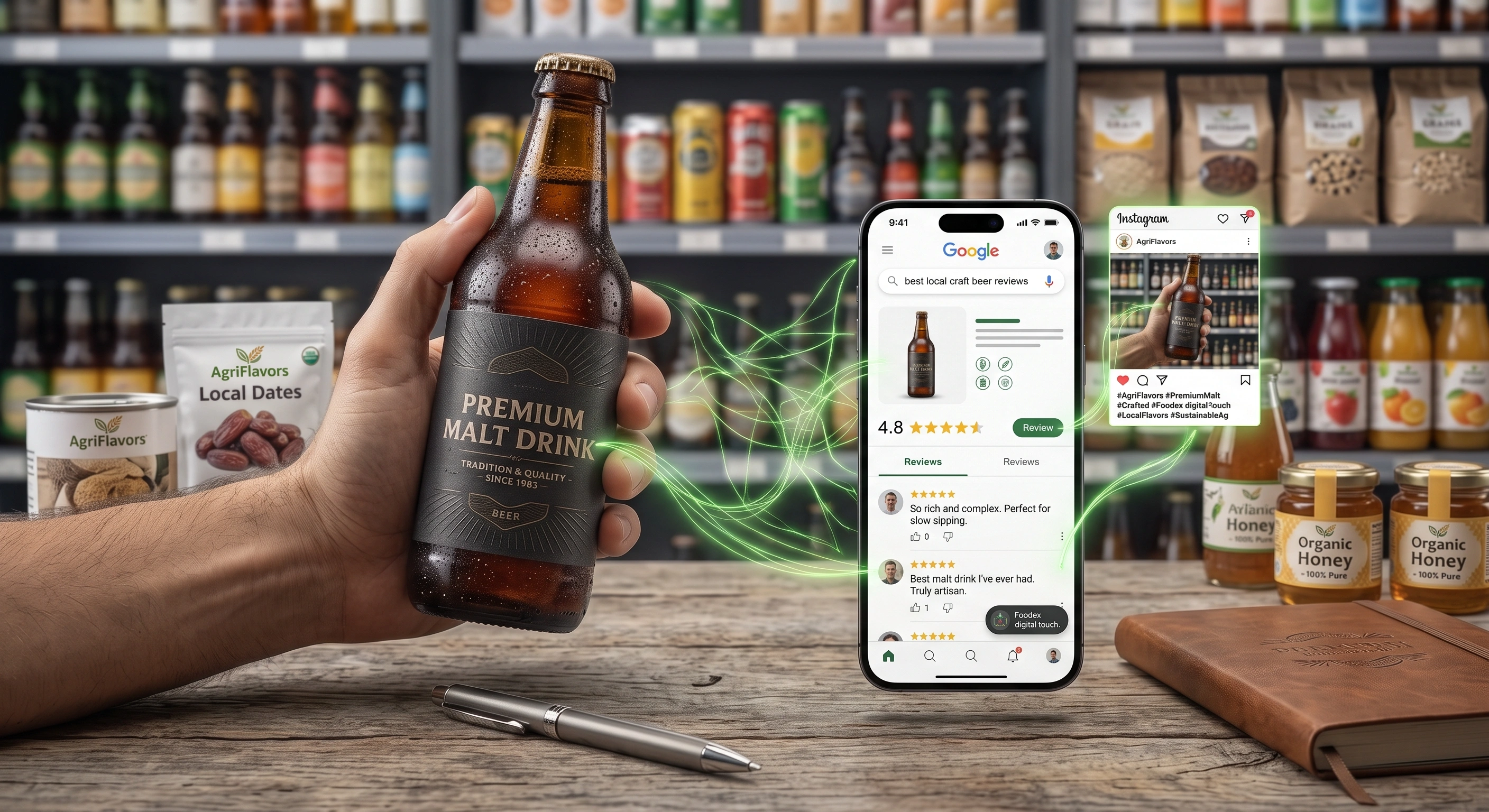
A shopper notices your product in a store.
They may not know the brand, but the packaging catches their attention. Maybe they buy it immediately. Maybe they do not.
Later, they search for the brand because they want to know:
Who makes this product?
What other products does the company offer?
What are the ingredients?
Where can I buy it?
Does the brand have distributors or representatives?
Who should I contact if I have a question, complaint or business enquiry?
That is where an important part of the customer journey begins.
When someone searches for your brand, are you answering those questions — or is the internet answering them for you?
Today, discovery rarely begins and ends on a brand website.
A consumer may first encounter a food product on a supermarket shelf, through social media, from a friend, in an online marketplace or through a retailer.
But when they want to investigate the brand itself, search remains one of the most important routes.
A 2026 Clutch study found that nearly 60% of consumers had discovered the most recent new brand they encountered through an online channel, while 43% of people actively researching a brand began with Google or another search engine.
The broader pattern is even more important: brand discovery is no longer linear. Search, social media, physical retail, word of mouth, marketplaces and AI-powered tools increasingly overlap.
For food brands, the implication is clear:
Being noticed on the shelf is not the end of the customer journey. It is often the beginning of another search.
And if the brand is not prepared for that search, part of the customer relationship is handed over to somebody else.
1- If Your Website Does Not Answer the Question, the Customer Will Look Somewhere Else
A weak website does not stop people from researching a brand.
It simply pushes them towards another source.
They may end up on:
- an online retailer,
- a social media profile,
- Google Maps,
- a company directory,
- a distributor’s website,
- an outdated article,
- or a third-party page that the brand itself did not create.
This is especially common in food.
At Foodex Iran, for example, we repeatedly see people arrive on a brand profile because they were actually trying to reach the food company itself.
They may be looking for:
- a product,
- a distributor,
- a sales contact,
- a representative,
- or someone at the company.
But because the brand does not have a strong website or a clear contact route, the person finds the Foodex Iran profile instead — and then contacts Foodex.
At first glance, this may appear to be a minor website problem.
From the brand’s perspective, however, something more important has happened:
The customer was looking for you, but you were not the primary source of information about yourself.
Third-party platforms, retailers and directories can all be valuable.
The problem is not their existence.
The problem begins when there is no clear, complete and current first-party source that everyone else can ultimately refer back to.
2- Food Brands Need an Official Digital Home More Than Many Other Businesses
A simple corporate website may be enough for some businesses.
A short company profile, a few service pages and a phone number may answer most customer questions.
Food brands usually face a more complicated information problem.
Every product can generate a new set of questions:
- What exactly is it?
- Which flavours or varieties are available?
- What sizes does it come in?
- What ingredients does it contain?
- How should it be prepared or consumed?
- Is nutritional information available?
- Does it carry certifications or specific claims?
- Where is it sold?
- Is it exported?
- Who should a wholesale buyer contact?
- What should a consumer do if there is a product issue?
As the portfolio grows, the number of questions grows with it.
That is why the website of a food brand should not be treated as a digital version of a corporate brochure.
It should become the official home of the brand’s product information.
A place where consumers, retailers, distributors, business partners, journalists and search systems can understand:
- who the brand is,
- what it sells,
- what its products are,
- and how to engage with the company.
3- An Instagram Account Is Not a Replacement for an Official Website
A reasonable question is:
“If our customers already follow us on social media, why invest in a website?”
Because discovery and reference are not the same thing.
Social platforms are extremely important for food brands.
NIQ reported in 2026 that roughly one in three consumers in Western markets now purchase products they first discovered through social media.
That makes social platforms powerful discovery channels.
But they are not structured brand knowledge systems.
On social media:
- content is time-based;
- important posts disappear beneath newer ones;
- product ranges are difficult to navigate;
- comparison is limited;
- information may be scattered across posts, stories and highlights;
- and the user experience depends heavily on the platform itself.
More importantly, the environment is not fully controlled by the brand.
The platform determines:
- how information is discovered,
- what gets shown,
- how people search,
- what formats are available,
- and how content is organised.
A website serves a different purpose.
Social media can help people discover the brand. The website should help them understand it.
These channels should support one another, not compete.
A mature digital presence gives each of them a clear role.
4- A Product Page Is More Than a Packshot and Two Lines of Copy
One of the most common weaknesses on food websites is the product page.
It often resembles a catalogue entry:
- a good image,
- the product name,
- two short sentences,
- and nothing else.
But someone searching for the product probably did not arrive simply to look at the same pack again.
They usually have a question.
Depending on the category, a strong product page may include:
- the exact product name,
- variant or flavour,
- available pack sizes,
- current packaging imagery,
- a clear description,
- ingredients,
- nutrition information,
- preparation or serving guidance,
- storage instructions,
- verifiable claims,
- relevant certifications,
- frequently asked questions,
- related products,
- and a route to purchase or find a retailer.
This matters for people.
It also matters for search systems.
Google provides specific ways for websites to mark up product information so search engines can better understand what is on the page.
This is where structured data becomes useful.
Structured data is information added to the page code in a standard format that helps a search engine recognise that:
- this is a product,
- this is the brand,
- this is the price,
- this is the availability,
- and these are other specific product attributes.
It does not guarantee special placement in search results.
But it makes the page easier for search systems to interpret correctly.
So a strong product page has two jobs:
It should be clear to a person and clearly interpretable by digital systems.
5- Contact Paths Should Be Designed Around Customer Intent
It sounds simple:
“We have a phone number on the website.”
But not everyone who contacts a food company wants the same thing.
One person wants to know where to buy the product.
Another has a question about ingredients.
A retailer wants to discuss wholesale supply.
An overseas buyer is interested in export.
A consumer wants to report a problem.
Someone else wants distribution rights.
If all of these users are pushed towards the same general number or an unclear form, the website is not doing enough.
A better structure makes the main routes obvious.
For example:
- Product Enquiries
- Customer Support
- Where to Buy
- Wholesale
- Distribution & Representation
- Export
- Business Partnerships
- Media & PR
This does not require a separate complex form for every possible scenario.
It requires clarity.
The user should know:
“For the thing I need, this is where I go.”
That small difference separates a website that merely exists from one that actually works.
6- Do Not Make Customers Become Detectives
Imagine that someone searches for one of your products.
They arrive on the website.
But the navigation reflects the company’s internal structure rather than the language customers use.
The product search does not work.
Pack sizes are unclear.
Old packaging is still displayed.
Discontinued products remain online.
New products have not yet been added.
Different variants are difficult to distinguish.
From inside the company, it may still feel like:
“We have a website.”
From the customer’s perspective:
Reliable information is difficult to find.
This is particularly important in food, where:
- packaging,
- flavours,
- formats,
- sizes,
- availability,
- distribution,
- and product ranges
can change regularly.
Digital quality is not determined only by how good the website looked on launch day.
It depends on whether the brand can keep it aligned with reality.
A beautiful site that becomes outdated within a year is not a strong digital asset.
7- Inconsistent Information Erodes Trust
Imagine this situation:
The official site lists one pack size.
An online retailer lists another.
The brand’s social profile still shows the previous packaging.
A business directory contains an old phone number.
A marketplace uses a product description the brand stopped using years ago.
The customer is left with a simple question:
Which one is correct?
Inconsistent product information has always been a problem.
AI-powered discovery makes it even more important.
NIQ’s 2026 analysis of AI-enabled shopping points to the growing importance of complete, consistent and structured product information.
Websites, retailer listings, reviews and other digital sources can all contribute to how a product is understood by new discovery systems.
If the information is incomplete, contradictory or outdated, the brand is more likely to be interpreted poorly.
This is why food brands need something close to a source of truth for product information.
A place where the approved version of the product information begins.
From there, retailers, marketplaces, social channels and other distribution points should remain as aligned with that source as reasonably possible.
In most cases, the strongest candidate for that role is the brand’s own digital property.
8- A Food Brand Website Is Not Only for Consumers
Many websites are designed around a single imagined visitor:
the end consumer.
But a food brand may be searched by many different groups:
- consumers,
- retailers,
- wholesalers,
- distributors,
- importers,
- restaurants,
- cafés,
- suppliers,
- journalists,
- investors,
- and job candidates.
They do not ask the same questions.
An international importer may be looking for:
- the product portfolio,
- current markets,
- certifications,
- production capabilities,
- export contacts,
- and corporate documentation.
A consumer may simply want to know:
“Where can I buy this near me?”
A professional website does not have to create the same journey for all of these audiences.
It should create clear, short routes for the most important needs.
That is part of digital experience design.
9- “Where Can I Buy It?” Should Never Become a Dead End
A food company may spend heavily on:
- advertising,
- retail activation,
- packaging,
- social media,
- sampling,
- and awareness campaigns.
The consumer becomes interested.
They search for the product.
They arrive on the website.
And then they cannot find out where to buy it.
At that point, part of the marketing investment has been wasted.
Not every food brand needs direct-to-consumer e-commerce.
In many cases, selling directly would not even make commercial sense.
But even without direct sales, the brand can help the customer take the next step.
That could mean:
- links to online retailers,
- a store locator,
- a list of major retail partners,
- regional distributors,
or a clear way to ask where the nearest stockist is.
The goal is not to turn every food website into an online store.
The goal is to ensure that:
Interest does not end in a digital dead end.
10- Google Should Be Able to Recognise the Official Brand Source
One of the most important roles of the official website is to establish digital identity.
Google recommends that organisations clearly provide information such as:
- organisation name,
- legal name where appropriate,
- logo,
- address,
- contact information,
- and other organisational identifiers.
This information can also be marked up through structured data to help search engines better understand the entity behind the website.
This becomes especially useful when:
- several companies have similar names,
- the consumer brand differs from the legal company name,
- the business operates in several countries,
- or products appear across many third-party websites.
In those situations, the official website becomes a kind of:
digital identity card for the brand.
That does not mean Google relies only on the company website.
It means the brand should provide the web with a clear, authoritative version of who it is.
11- AI Is Becoming Part of Product Discovery Too
Until recently, the discovery pattern was fairly predictable.
A consumer had a question.
They searched Google.
They opened several pages.
They compared the information themselves.
That behaviour is changing.
In August 2026, NIQ reported that 74% of surveyed shoppers were using AI in some form of product discovery.
AI tools are increasingly used to:
- compare products,
- narrow down options,
- find alternatives,
- research prices,
- and explore unfamiliar categories.
For food brands, that creates a new question.
A few years ago, brands mainly needed to ask:
“If someone searches our name, can they find our website?”
Now there is another question:
“Is our product information clear, complete and consistent enough for AI and search systems to understand what we actually offer?”
This does not mean websites should be written for machines instead of people.
The fundamentals remain human.
People want:
- accurate information,
- clear structure,
- understandable product descriptions,
- credible claims,
- current details,
- and obvious next steps.
Those same qualities also make information easier for digital systems to interpret.
12- If AI Describes Your Product Incorrectly, the Problem May Not Be AI Alone
Imagine someone asks an AI assistant:
- “Does this brand have a sugar-free product?”
- “Who is this product suitable for?”
- “Where can I buy this brand?”
- “Does this company export?”
If the official website contains little or no useful information, the system has to look elsewhere.
It may rely on:
- retailer descriptions,
- old articles,
- discussion forums,
- user reviews,
- business directories,
- or outdated listings.
Some of those sources may be useful.
Others may be incomplete.
The risk of an inaccurate or outdated answer therefore rises.
NIQ’s 2026 work on AI-driven commerce highlights the importance of complete, consistent and structured product data for brands that want to remain discoverable as new product-recommendation systems develop.
A company cannot control the entire internet.
But it can do one important thing:
Become the best available source of information about itself.
13- A Strong Website Can Reduce Unnecessary Communication Work
Suppose the same questions arrive every week:
- “Where is this product sold?”
- “Do you have a distributor?”
- “What is the export department’s contact information?”
- “What are the ingredients?”
There are two possibilities.
Either these questions genuinely require human assistance.
Or the website has failed to answer something people repeatedly need to know.
Repeated enquiries are valuable signals.
They reveal missing information in the digital experience.
A strong website can answer simple, recurring questions before a customer needs to call or message anyone.
That leaves human support available for cases that genuinely require attention.
The website therefore does not serve only marketing.
It can support:
- customer service,
- sales,
- export,
- public relations,
- and product information management.
14- More Content Does Not Automatically Mean a Better Digital Presence
The solution is not to create hundreds of pages.
A food brand may publish dozens of articles while customers still cannot find its sales contact.
The website may be large but the product pages remain incomplete.
The news section may update weekly while the product catalogue is two years out of date.
A strong digital presence depends more on information priorities than information volume.
For most food brands, these foundations should come first:
Brand Identity
Who are we, and how should people recognise us?
Products
What exactly do we sell?
Trust
Why should people believe our information and claims?
Availability
Where can the product be found or purchased?
Contact
Where should each type of enquiry go?
Knowledge
What useful information can we provide that helps people choose, understand or use the product?
Once these foundations are strong, content marketing, search visibility, storytelling and more advanced digital experiences become significantly more valuable.
Test Your Brand’s Digital Presence Today
There is a simple exercise any food company can perform.
Open a private or incognito browser window so that your previous browsing history has less influence on what you see.
Search for the brand name.
- Then try some realistic customer queries:
- [Brand Name] products
- [Product Name]
- [Brand Name] contact
- [Brand Name] distributor
- [Brand Name] where to buy
- [Brand Name] export
- [Product Name] ingredients
Now look carefully at the results.
- Is the official website the strongest answer?
- Are the details current?
- Are the latest product images visible?
- Is the contact information correct?
- Can the shopper find where to buy the product?
- Do third-party websites provide more useful information about your products than you do?
If the answer to the last question is yes, the problem is bigger than SEO.
The brand’s digital information architecture needs attention.
Food Brand Digital Presence Checklist
Before saying, “We already have a website,” ask:
- When the brand name is searched, is the official website easy to recognise?
- Can a new visitor understand the product portfolio within seconds?
- Does every important product have a complete and current page?
- Do the images match the packaging currently available in market?
- Can shoppers easily find information such as variants, sizes, ingredients and usage?
- Can they find where to buy the product?
- Are customer service, sales, distribution, export and business enquiries clearly separated?
- Are the company name, logo, address and official details consistent across the website?
- Is the website broadly consistent with important retailer and marketplace listings?
- Can search engines clearly understand the organisation and its products?
- Is the website fast and usable on mobile devices?
- Are product information and key content reviewed and updated regularly?
- Can someone with no previous knowledge of the brand build enough trust from the site?
- Would an AI system have enough reliable first-party information to understand the brand and its products correctly?
- After becoming interested, does the visitor know what to do next?
Having a website does not automatically produce a positive answer to any of these questions.
If You Are Not the Official Source, Someone Else Will Fill the Gap
The goal is not to make everyone visit only the official website.
A strong food brand should be visible across:
- retailers,
- social platforms,
- maps,
- marketplaces,
- industry websites,
- media,
- and specialist directories.
That is part of the modern buying environment.
But among all these touchpoints, there still needs to be a reliable centre.
A place that customers, business partners and digital systems can refer back to when they need the clearest version of the brand.
Ideally, that centre should belong to the brand itself.
Because if a company does not publish its own:
- story,
- product information,
- contact routes,
- availability,
- and official details
clearly enough, the internet does not remain silent.
Retailers will create product descriptions.
Customers will share experiences.
Directories will build profiles.
Other websites will write about the brand.
AI systems will synthesise answers from whatever sources they can find.
The real question is therefore no longer:
“Does our brand exist online?”
Almost every established brand does.
A much more important question is:
“Are we actively shaping our own digital presence?”
From Digital Brochure to Brand Infrastructure
A strong website is not designed to replace retailers, social platforms, advertising or human communication.
Its role is to connect those channels to a clear and trustworthy centre.
A consumer may:
- discover the product on a supermarket shelf,
- see it again on social media,
- search the brand on Google,
- review the product on the official site,
- buy it from an online retailer,
- and return several weeks later with a question.
That journey is no longer linear.
Food brands need to be present across multiple points in the journey — but their identity and information should not become completely different at each one.
That is why designing the digital presence of a food brand should not begin with:
- the homepage color,
- the hero banner,
- or the latest visual trend.
It should begin with a much more practical question:
When someone is genuinely looking for your brand, do they find what you would want them to know?
If the answer is unclear, the website is not merely a design project waiting to be improved.
It represents an underused commercial, communication and brand-building opportunity.
Sources
- Clutch — The New Rules of Brand Discovery: How Consumers Find Brands in 2026.
- Research on how consumers discover and actively investigate brands across search, social media, physical retail and other channels.
- NielsenIQ — How AI in Personalized Shopping Is Transforming the Way Consumers Discover Products, 2026.
- Analysis of AI-assisted shopping and the growing importance of complete, consistent and structured product information.
- NielsenIQ & World Data Lab — 74% of Shoppers Use AI for Discovery, 2026.
- Research on the growing role of artificial intelligence in product discovery and comparison.
- NielsenIQ — 42% of Consumers Now Use AI Tools to Shop, 2026.
- Research on the use of AI for product research, comparison and narrowing down purchase choices.
- NielsenIQ — One in Three Western Consumers Now Buy Products Discovered on Social Platforms, 2026.
- Research on social platforms as product-discovery channels and their connection with later purchase behaviour.
- Google Search Central — Add Business Details to Google and Organization Structured Data.
- Official guidance on providing clear organisation identity, business details and structured information through an official website.
- Google Search Central — Product Structured Data and Share Your Product Data With Google.
- Official guidance on structuring product information so search systems can better understand product pages and associated data.