
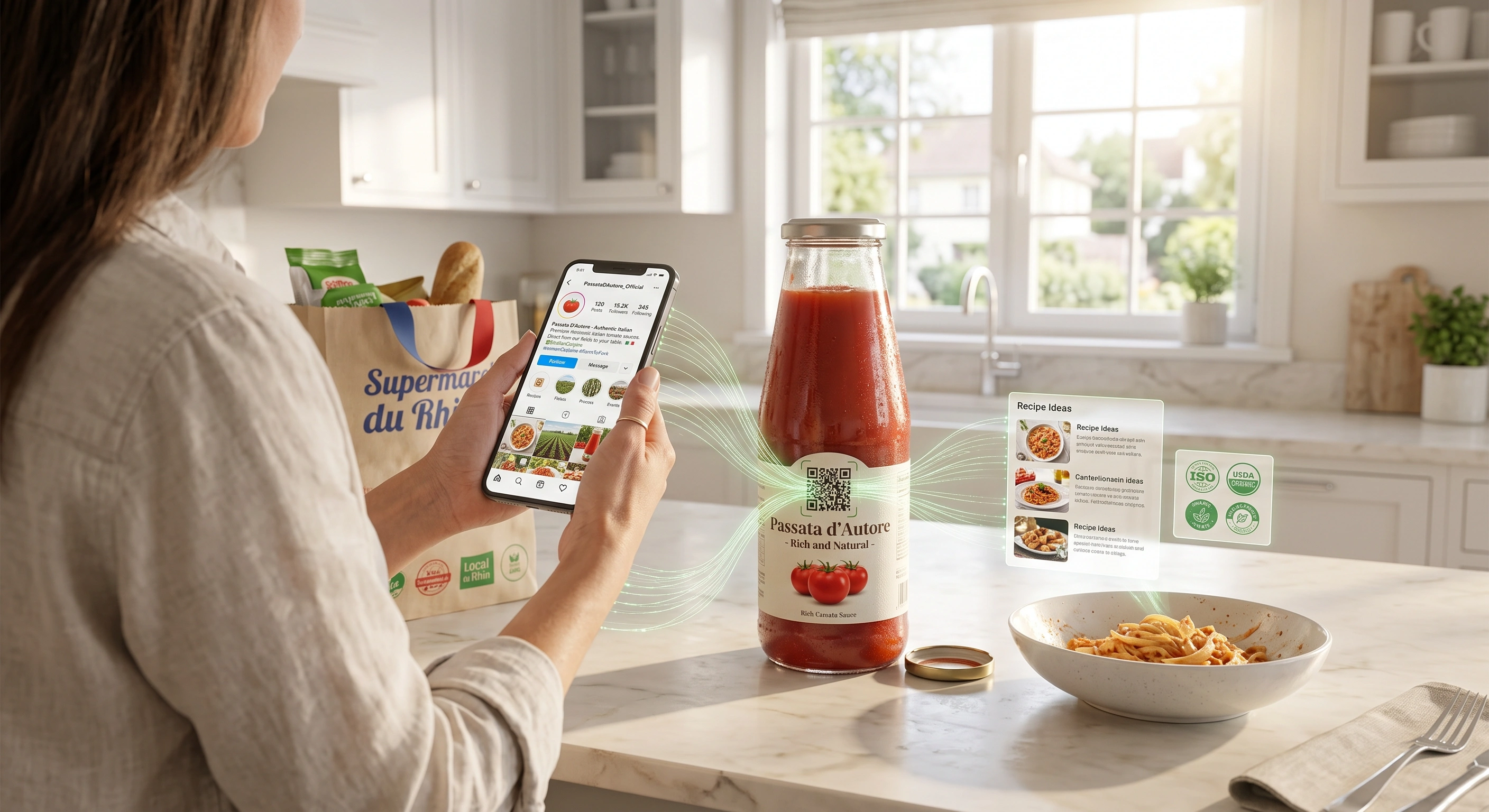
Buying a pack of biscuits, yogurt, juice or rice rarely looks like buying a car or a smartphone.
Most consumers do not spend days researching every food purchase. They do not read ten articles, compare extensive specifications and then make a carefully considered decision.
Many food choices happen in the store.
The shopper enters the aisle.
They scan the shelf.
They recognise familiar brands.
They notice prices.
They compare packs.
A new product may catch their attention.
And within a short period of time, they decide.
For repeat purchases, even this process may be shorter. The shopper already knows the product, picks it up almost automatically and moves on.
That does not make digital touchpoints irrelevant.
It simply means their role in food purchasing is more nuanced.
Sometimes digital information appears before the purchase.
Sometimes it enters the journey while the shopper is standing in front of the shelf.
Sometimes it becomes important only after the product has been consumed.
And sometimes it matters when a satisfied customer wants to find the product again, learn more about it or share their experience.
So the central question is not:
“Do people research food products online before buying them?”
A better question is:
“At which moment in the product experience can digital actually create value for the customer?”
Three “Moments of Truth” Still Help Explain Food Buying Behaviour
Years ago, Procter & Gamble popularised the idea of the First Moment of Truth, or FMOT: the point at which a shopper first encounters a product on the shelf and makes a choice between alternatives.
The Second Moment of Truth, or SMOT came after purchase: the moment when the product is opened, used or consumed, and the customer discovers whether the brand promise holds up in reality.
Google later introduced the Zero Moment of Truth, or ZMOT: the moment before purchase when people search, compare, read reviews or seek information that may influence the decision.
The original ZMOT framework dates back to 2011, so it should not be treated as a complete model of today’s digital behaviour.
But one part of the framework is still highly useful for food and FMCG:
These moments do not carry equal weight in every product category.
In Google’s original ZMOT research, grocery and packaged consumer goods remained strongly influenced by FMOT. The point is not to reuse those old percentages as current market data, but to recognise a structural reality that still matters:
For many food products, the shelf and the immediate moment of choice remain extremely important.
Current omnichannel data points in the same direction.
NielsenIQ continues to show that physical retail still accounts for the majority of grocery sales, while online grocery is growing rapidly and digital tools increasingly influence both online and in-store decisions.
This means a food brand should not automatically design the customer journey as though it begins with a Google search.
For many products, the journey begins with the shelf, the consumption experience, or another immediate trigger.
1- Before Purchase: Does Research Even Happen?
Sometimes it does.
Sometimes it does not.
And that distinction matters.
Pre-purchase research is more likely when:
the product is new to the shopper;
the price is relatively high for its category;
the product makes health or nutrition claims;
allergens or dietary restrictions are important;
the product is specialised;
the shopper needs to understand a meaningful difference between options;
or the purchase begins online.
But for many everyday categories — beverages, snacks, dairy, familiar staples or frequently repurchased products — ZMOT may be extremely brief or may not happen before purchase at all.
It may happen in the store.
FMI’s 2026 grocery research shows that large numbers of shoppers use digital tools both before and during grocery shopping. In-store digital activity may include retailer apps, search, websites, promotions and other tools.
That means today’s ZMOT can be as simple as this:
A shopper is standing in front of two products.
They take out their phone.
They spend thirty seconds checking price, ingredients or one specific claim.
Then they decide.
That is very different from a multi-day “research stage”.
2- For Many Food Brands, the Shelf Is Still the Critical Moment
This is FMOT.
The point where:
- packaging,
- price,
- pack size,
- promotion,
- shelf position,
- number of facings,
- brand familiarity,
- and nearby competitors
all influence the decision simultaneously.
Digital does not need to replace this moment.
It should support it when necessary.
Imagine a shopper discovers a new product and has one specific question:
“Is this gluten-free?”
Or:
“What is the difference between this flavour and the one next to it?”
Digital information can be useful if it answers that question immediately.
But if the shopper has to:
open the homepage,
search through three menus,
find the product again,
scroll through multiple sections,
and download a PDF,
the digital experience has failed the moment.
At the point of purchase, speed of access matters more than volume of information.
3- Not Everything Belongs Online
This is particularly important in food.
Information required for safe and correct use should not be hidden behind a website or QR code.
If the product requires:
- specific storage conditions,
- allergen warnings,
- essential preparation instructions,
- cooking time,
- important dosage guidance,
- or safety information,
that information should be available on the packaging or accompanying material as required by the relevant market.
Digital should extend essential information, not replace it.
A website or QR experience may provide:
- video preparation guides,
- alternative recipes,
- product comparisons,
- ingredient origin stories,
- deeper certification information,
- serving ideas,
- sustainability details,
- or other supporting content.
The distinction is important:
The pack should provide what the customer needs. Digital can provide what helps the customer go further.
4- A QR Code Is Useful Only When There Is a Clear Reason to Scan It
A QR code can be one of the most natural links between a physical food product and a digital experience.
But only if the customer understands why scanning it is worth their time.
A generic:
“Scan Me”
is not a value proposition.
A stronger reason might be:
See full ingredient information
Explore the product’s origin
Discover recipes
Verify authenticity
Learn how to recycle the pack
or something else directly relevant to the product.
This is where GS1 Digital Link becomes useful.
GS1 is the global standards organisation behind widely used product identification and data standards. Digital Link allows a product identifier carried in a QR code or other 2D barcode to connect the physical product with digital information and services.
That may include:
- ingredients,
- allergens,
- nutrition information,
- sustainability information,
- recipes,
- or product-specific content.
The important point is that the QR code stops being a random shortcut to the company homepage.
It can become a digital entry point for that exact product.
5- In Food, Social Media Often Creates Curiosity Rather Than “Research”
This is an important distinction.
For many food categories, social media does not send people into a long decision process.
It may simply:
introduce a new flavour;
show an interesting use case;
make a product memorable;
create appetite;
or give someone a reason to try it.
NielsenIQ’s 2026 research shows that social media plays a growing role in food and beverage discovery, while many digitally discovered products are still ultimately searched for or purchased in physical grocery environments.
So for many products, the real pattern is:
Digital discovery → shelf selection
rather than:
Digital discovery → brand website → long research process → online purchase
That difference matters.
If social content creates curiosity around a new product, the next priority may be to ensure that:
the product is easy to recognise on shelf;
the packaging matches what the shopper saw online;
and the customer can quickly find where it is sold.
It may not be necessary to push the person through multiple pages of brand content first.
6- The Physical Shelf and the Digital Shelf Should Show the Same Product
Even customers who complete their purchase in-store may encounter a digital version of the product beforehand.
In:
- a retailer app,
- an online grocery store,
- Google,
- social media,
- or the official brand website.
If the online image shows old packaging while the new pack is already in stores, recognition becomes harder.
If the product name online does not match the pack, search becomes more difficult.
If weight, flavour or claims differ across channels, trust can decline.
NielsenIQ increasingly treats the digital shelf as relevant not only to e-commerce, but also to discovery and comparison for purchases that ultimately happen in-store.
So consistency matters:
Same product.
Same name.
Same current pack.
Same core attributes.
The customer sees one brand.
They do not see the internal teams responsible for different channels.
7- After Purchase, the Second Moment of Truth Begins
For food products, this may be more important than many digital interactions.
The packaging worked.
The promotion worked.
The product was purchased.
Now the customer opens it.
Smells it.
Tastes it.
Feels the texture.
Prepares it.
Shares it with someone.
And decides:
Was this worth buying?
That is SMOT.
If the actual experience contradicts the promise created by the packaging and marketing, no website can fully repair the gap.
For fast-moving consumer goods, one of the most commercially important outcomes of the customer journey is often very simple:
Will this product go into the basket again?
Digital experience after purchase should support the product experience.
It should not try to substitute for it.
8- After Consumption, the Reason for Searching Changes
This is where digital activity may begin rather than end.
A customer has already bought the product.
Now they may want to:
find another way to use it;
look for recipes;
learn how to store it;
understand where the ingredients come from;
discover other products from the same brand;
read other consumers’ experiences;
or leave a review themselves.
For products such as:
- sauces,
- spices,
- flour,
- grains,
- coffee,
- specialty ingredients,
- or unfamiliar food products,
post-purchase search may be more meaningful than pre-purchase research.
This is where a brand website and content strategy can create genuine value.
Not by repeating the packaging.
But by helping the customer use the product better and get more from it.
9- A Website Should Not Replace Essential Instructions, It Should Expand Usage Occasions
This is an important distinction.
If a product requires essential preparation instructions, those instructions should not exist only online.
But the website can do something more valuable.
A pasta brand can show:
three different ways to cook with the product.
A coffee brand can explain:
which brewing methods suit a particular roast.
A cheese brand can offer:
different meal ideas.
A spice brand can suggest:
which foods pair particularly well with a blend.
In this context, content is no longer simply “how to use the product”.
It creates additional occasions to use the product.
For fast-moving consumer goods, that can be commercially important because more usage occasions can contribute to higher consumption frequency and, eventually, repeat purchase.
10- Contacting the Brand Is a Support Path, Not the Main Journey
For most everyday food purchases, a customer is unlikely to fill in a detailed form after consuming a snack or drink.
If they have a simple question, they will probably use the fastest available route:
- search,
- social media,
- messaging,
- phone,
- or a clear FAQ.
A form becomes useful when structured information is genuinely necessary.
For example:
- a quality complaint;
- a production batch issue;
- a trade enquiry;
- a distributor application;
- or another matter that needs formal follow-up.
In a product-quality case, details such as:
- product name,
- batch number,
- expiry date,
- photographs,
- and place of purchase
- may be essential.
But for a question such as:
“Where can I buy this in Melbourne?”
a six-step form would be unnecessary friction.
The better principle is:
Give each need the shortest appropriate path.
11- A Good Digital Experience Can Shorten the Distance Between First Purchase and Repeat Purchase
For many food brands, the long-term commercial value is not in the first transaction.
It is in repeat purchase.
If the product delivers a good experience, the next purchase should become easier.
That may happen through:
- a clear product page;
- retailer links;
- store availability;
- easy product recognition;
- saved favourites in online grocery;
- or useful brand content that keeps the product mentally available.
The point is not to build a complicated marketing funnel around a bottle of juice.
The point is to avoid creating unnecessary friction between:
product satisfaction and buying it again.
12- Not Every Food Category Has the Same Customer Journey
This is essential to any serious food-industry strategy.
Buying a bag of chips is not the same as buying:
- baby food,
- specialty coffee,
- premium saffron,
- fresh meat,
- gluten-free products,
- functional foods,
- or high-priced olive oil.
NielsenIQ’s omnichannel research repeatedly shows that digital adoption varies across grocery categories, while fresh products remain more dependent on physical-store behaviour than some packaged categories.
The broader principle is:
The higher the decision involvement, the greater the likely role of pre-purchase information.
Decision involvement can increase because of:
- higher price;
- health risk;
- dietary requirements;
- product unfamiliarity;
- meaningful differences between alternatives;
- or emotional importance.
For a familiar, inexpensive, frequently purchased product, FMOT and previous experience may dominate the decision.
For a specialised product, digital information may become much more important before purchase.
There is no single journey map for “food”.
13- Online Grocery Changes the Environment, Not the Nature of the Decision
When food shopping moves online, the physical shelf becomes a digital shelf.
But many of the same decision questions remain:
- Do I know the brand?
- Is the image clear?
- What is the price?
- Is it available?
- Is the pack size right?
- Which flavour do I want?
- What do the reviews say?
FMI and NielsenIQ have reported strong growth in online grocery and widespread adoption of omnichannel buying behaviour.
But that does not mean every food purchase suddenly becomes research-intensive.
Many customers use digital grocery stores to repurchase familiar products even faster than they would in-store.
So digital food experiences need to support two very different behaviours:
discovering something new and reordering something familiar.
Those are not the same design problem.
14- Digital Data Should Tell Us Which Moment Actually Matters
One advantage of digital channels is that some points of friction are measurable.
A brand can look at:
which pages users leave most often;
what people search for internally;
which site searches return no results;
how many users click “Where to Buy”;
how many move from product pages to retailer links;
which QR codes are scanned;
which content brings customers back to product pages;
which products get high attention but low purchase activity;
and which questions appear repeatedly in customer support.
These are not just marketing metrics.
They can reveal breaks in the product journey.
For example, if hundreds of people search:
“where to buy in Brisbane”
and no page answers that question, the users themselves are telling the brand what is missing.
Good analytics means using real behaviour to improve the journey.
Not simply producing a more sophisticated dashboard.
15- A Better Model for Food: A Cycle, Not a Funnel
For many food products, the customer journey makes more sense as a cycle.
A- Trigger or Discovery
The customer encounters the product through:
- a shelf,
- an ad,
- social media,
- a friend,
- a restaurant,
- an online retailer,
- or another context.
B- Moment of Choice
For many packaged food products, this is FMOT.
Packaging, price, familiarity, placement and availability all influence the decision.
C- Digital Support, If Needed
This step may not happen for everyone.
It may occur before or during purchase.
Possible needs include:
- price,
- nutrition,
- reviews,
- availability,
- comparison,
- or more product information.
D- Actual Product Experience
SMOT.
Taste, quality, texture, ease of use and the reality of the brand promise are tested.
E- Experience Extension
If relevant:
- recipes,
- product knowledge,
- origin stories,
- education,
- support,
- or reviews.
F- Repeat Purchase
If the experience was positive, the product should be easier to find and buy the next time.
G- Experience Becomes Influence
The customer may:
- recommend it;
- review it;
- create content;
- or tell someone else.
And this is where the cycle becomes particularly interesting:
One customer’s SMOT can become another customer’s ZMOT.
A positive experience becomes a review.
A review becomes pre-purchase information for someone else.
The journey is therefore not linear.
It loops.
The Role of Each Digital Channel in the Food Customer Journey
Once this logic is clear, each channel can have a more realistic role.
Social Media
Discovery, appetite, usage inspiration and brand recall.
Official Website
Authoritative information, deeper product knowledge, education and links to purchase.
Online Retailer
Availability, price, selection, comparison and transaction.
QR Code on Pack
A bridge between the physical product and relevant digital content.
Blog and Educational Content
Category education, usage expansion and product knowledge.
Messaging or Customer Support
Fast answers and problem resolution.
Structured Forms
Only when the request genuinely requires specific information and formal follow-up.
No single channel needs to do everything.
That is usually where bad digital journeys begin.
A More Realistic Customer-Journey Test for Food Brands
Instead of starting with a website diagram, choose one real product and test several realistic scenarios.
Scenario 1: Habitual Purchase
I have bought this before.
Can I recognise and find it quickly in-store or online?
Scenario 2: First-Time Discovery
I have never seen this product before.
Can I understand what it is and why it might interest me?
Scenario 3: Specific Question
I need to check an allergen, ingredient or product attribute.
Can I find the answer quickly?
Scenario 4: After Purchase
I liked the product and want another way to use it.
Does the brand offer anything genuinely useful?
Scenario 5: Repeat Purchase
A month later, I want the same product again.
Can I remember and identify the right pack or variant and find where to buy it?
These scenarios are usually far more realistic for a food brand than a long, idealised journey from “awareness” to “contact form”.
Food Product Digital Journey Checklist
Before claiming that the digital experience is complete, ask:
- Do we understand whether this product is usually bought habitually, impulsively or through planned consideration?
- Do we know whether the main decision usually happens before the store or at the shelf?
- If a shopper has one quick question during purchase, can they find the answer easily?
- Are essential safety and usage instructions available on-pack rather than pushed into digital channels?
- If the package includes a QR code, is there a clear reason to scan it?
- Does the QR code lead to relevant, live, mobile-friendly information about that exact product?
- Are the product name, imagery and key attributes aligned across shelf, website, social media and retailer listings?
- Does social content merely attract attention, or does it also make the product easier to recognise and find?
- Can digital content extend the product experience after purchase?
- Does the website create additional usage occasions where relevant?
- Is customer support designed around the seriousness of the issue rather than forcing every user into a form?
- Is repeat purchase easier for satisfied customers?
- Do we distinguish between low-involvement everyday products and higher-involvement food categories?
- Do physical and digital retail experiences reinforce one another?
- Are digital metrics used to identify real customer problems rather than simply report traffic?
If several of these answers are no, the problem may not be a lack of digital activity.
It may be that the existing pieces are not connected to the moments that actually matter.
Good Digital Experience Means Intervening at the Right Moment
The goal of digital experience for a food brand is not to force customers to interact with the brand at every possible stage.
Sometimes a good experience means:
the customer can choose the product without ever needing the website.
Sometimes it means:
one question is answered in ten seconds.
Sometimes it means:
a customer discovers a useful recipe after purchase.
And sometimes it means:
they can find the same product again next month without unnecessary effort.
That is very different from assuming every customer should:
visit the website,
read content,
complete a form,
and enter a marketing funnel.
For many food products, that behaviour would be unnatural and unnecessary.
A professional customer-journey strategy begins with a much simpler question:
“What is the customer actually trying to do at this moment, and does digital make that task easier?”
Once that becomes the organising principle, technology stops being separate from the product experience.
- The shelf,
- the package,
- social content,
- the website,
- online retail,
- QR codes,
- the consumption experience,
- and repeat purchase
become parts of the same cycle.
And for a food brand, the effectiveness of that cycle can ultimately be judged by something very simple:
Was the product chosen, did it deliver a good experience, and was it chosen again?
Sources
- Google / Shopper Sciences — Winning the Zero Moment of Truth, 2011.
- The original ZMOT framework and its relationship with FMOT and SMOT. Historical data from this research is used here as conceptual context rather than as a current measure of shopper behaviour.
- FMI — U.S. Grocery Shopper Trends 2026.
- Research on how grocery shoppers use digital tools before and during the shopping process, including in-store digital behaviour.
- FMI & NielsenIQ — 2026 Omnichannel Grocery Research.
- Referenced for the continued importance of physical grocery retail, the rapid growth of online grocery and the normalisation of omnichannel grocery shopping.
- NielsenIQ — The Digital Shelf: The Anchor of Omnichannel Success in 2026.
- Referenced for the relationship between digital product information, comparison, availability and both online and in-store grocery decisions.
- NielsenIQ — 2026 Research on Social Discovery in Food and Beverage.
- Referenced for the growing role of social platforms in product discovery and the way digital discovery can still lead back to physical-store selection.
- NielsenIQ — Category Shopping Fundamentals.
- Referenced for the differences between planned, habitual and impulse purchasing behaviour across consumer categories.
- GS1 — GS1 Digital Link and 2D Barcodes for Consumer Engagement.
- Referenced for the use of product identifiers and 2D barcodes to connect physical products with relevant digital information such as ingredients, allergens, nutrition, sustainability and recipes.