
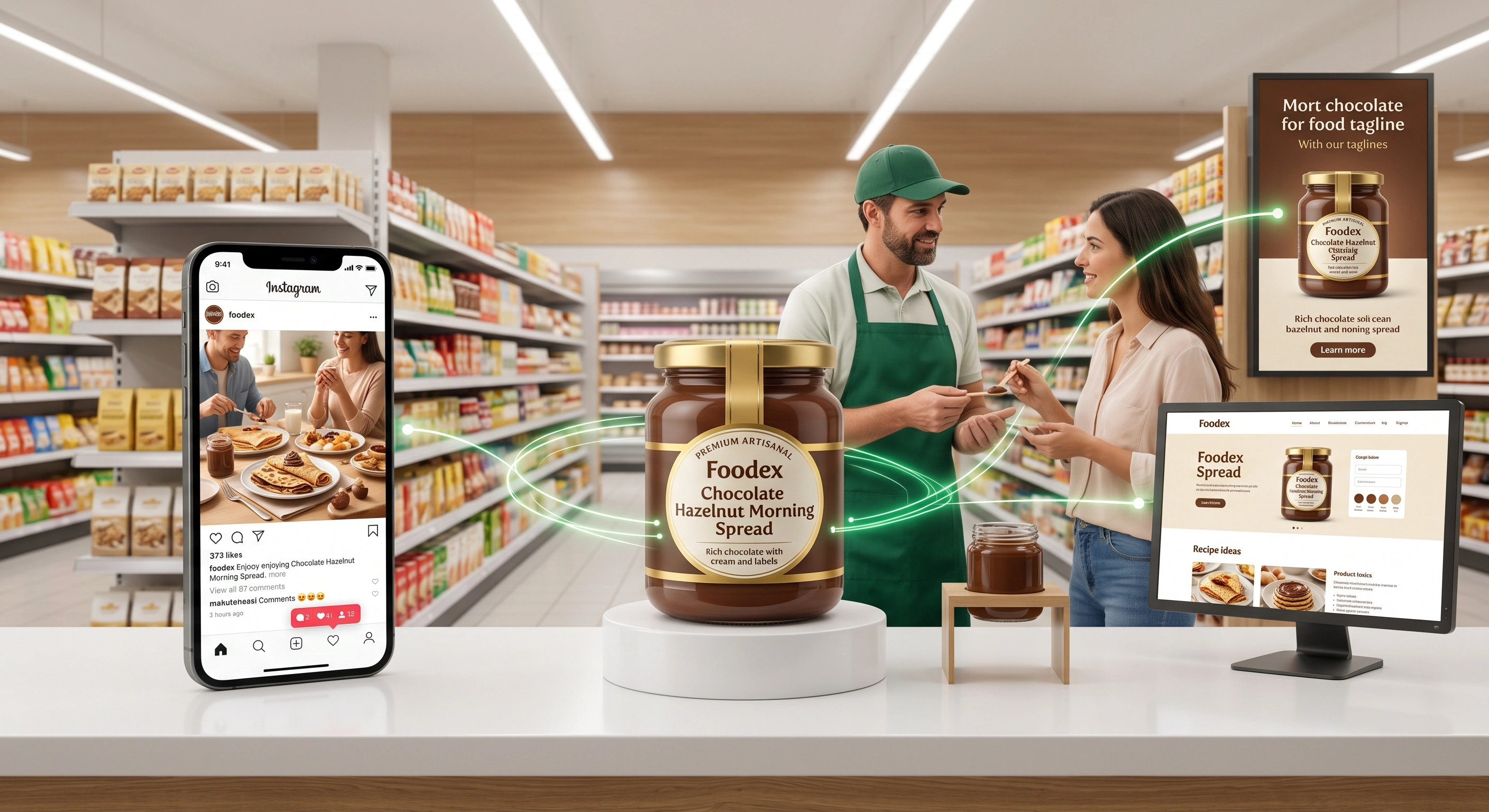
How Food Brands Can Turn Multiple Channels Into One Integrated System?
A food brand launches a new product.
On Instagram, the campaign tells an emotional story.
Creators talk about taste.
In-store, the product is heavily discounted.
The e-commerce listing still shows an older pack.
The brand website leads with a different product benefit.
The sales team tells retailers another story.
Outdoor media carries only the product name and a short tagline.
From an activity report, the brand appears to be everywhere.
But ask the consumer one simple question:
What was this campaign actually about?
The answer may be surprisingly unclear.
That is the difference between being present across multiple channels and running an integrated campaign.
Integration does not mean distributing the same advertisement in different sizes across television, social media, retail and the brand website.
Nor does it mean forcing every touchpoint to repeat the same sentence.
A more useful definition is:
An integrated campaign is a system of different touchpoints, each with a specific role, working toward the same commercial problem, communication logic and recognisable brand meaning.
In a well-designed system, consumers do not need to see identical content everywhere.
But each encounter should feel like another part of the same idea.
For food brands, this is especially important because the customer journey may move through:
- social media,
- creator content,
- retail media,
- e-commerce,
- the physical shelf,
- packaging,
- the product itself,
- and eventually repeat purchase.
If those elements work independently, the brand may have a lot of activity.
It may still not have a coherent campaign.
Multichannel Is Not the Same as Integrated
Imagine a brand active across six channels:
- social media,
- online video,
- out-of-home,
- creators,
- retail media,
- and in-store activation.
That tells us the campaign has reach across multiple environments.
It tells us nothing about whether those environments reinforce one another.
Kantar’s cross-media research has repeatedly suggested that campaign effectiveness can benefit from media working together rather than operating as isolated exposures. In its 2025 Media Reactions work, Kantar estimated that roughly 45% of campaign impact on brand outcomes could be associated with the combined contribution of channels working together.
Kantar has also reported stronger average performance for campaigns that are both integrated and adapted to the specific media environment, compared with campaigns that are neither well integrated nor well adapted.
Those findings should not be interpreted mechanically.
An academic study published in Decision Support Systems in 2024 also showed that multimedia advertising effects can vary across consumer groups and that repeated exposures do not produce linear returns.
The practical conclusion is more cautious:
The value of a multichannel campaign does not come from the number of channels. It comes from the way those channels work together.
More media does not automatically create more coherence.
Why Integration Is More Complicated in Food
For many food products, the customer journey does not take place inside one media environment.
A product may first appear in a creator video.
The customer may later compare it on a retailer website.
Then encounter it physically on shelf.
Packaging may influence the final decision.
The actual eating experience may determine whether the product is purchased again.
In the U.S., 2026 research from FMI and NielsenIQ continues to show that physical stores account for the majority of grocery sales, while e-commerce remains an important source of growth. The same body of work also identifies retail media as an increasingly important tool for product discovery and trial.
Social platforms are playing a larger role in food discovery as well, particularly in categories such as snacks and beverages.
This creates a fragmented-looking but highly connected environment:
digital discovery can lead to physical purchase; physical purchase can lead back to digital research; retail media can influence both.
Consumers do not experience these as separate organisational departments.
They experience one brand.
The fragmentation usually exists inside the company:
- content,
- performance marketing,
- sales,
- trade marketing,
- PR,
- retail,
- and e-commerce
may all be managed separately.
The challenge is therefore not simply media coordination.
It is commercial and organisational coordination around one customer experience.
The Problem Begins When Every Channel Builds Its Own Campaign
This is common.
The social team wants engagement.
The sales team wants the promotion to lead.
The advertising agency wants an emotional creative idea.
Creators reinterpret the product in their own style.
The commerce team wants immediate conversion.
Retailers want a strong offer for that week.
None of these objectives is necessarily wrong.
The problem appears when there is no higher-level logic connecting them.
A single product can then be positioned as:
“a more enjoyable choice” in one channel;
“the healthier option” in another;
“exceptional value” in-store;
and “a lifestyle product” in creator content.
The consumer receives four messages.
None becomes strong enough to organise memory.
Integration fails when local channel objectives start rewriting the brand strategy.
Start With the Business Problem, Not the Channel Plan
An integrated campaign should not begin with:
Which platforms should we use?
It should begin with:
What exactly needs to change?
Suppose a brand assumes its problem is low awareness.
But research shows consumers already know the product. They simply do not understand when to use it.
The real problem is not awareness.
It is consumption occasion development.
Another brand may face:
low understanding of product differentiation;
strong digital interest but weak shelf recognition;
high trial but poor repeat;
strong brand awareness but low consideration among a new audience.
These are different problems.
They require different campaign architectures.
If the central problem is incorrectly defined, integration simply means:
every channel becomes better coordinated around the wrong objective.
That is not strategic alignment.
It is efficient misdirection.
So before campaign design, ask:
Which behaviour, perception or commercial barrier are we actually trying to change?
Then Build an Organising Idea
Once the problem is clear, the campaign needs something capable of organising multiple executions.
This is not necessarily a tagline.
The organising idea might be:
- a behaviour;
- a consumption occasion;
- a product truth;
- a customer tension;
- a cultural observation;
- a challenge;
- or an experience.
Consider a sauce brand that wants to increase usage frequency.
If consumers currently associate the product with only one meal, the campaign problem may be limited usage occasions.
The organising idea could therefore be about making the sauce useful across more everyday meals.
That same idea could appear differently across channels:
A creator demonstrates an unexpected use.
Brand video dramatises different meal occasions.
Retail media places the product near complementary foods.
E-commerce bundles it with relevant ingredients.
The website publishes practical recipes.
Packaging directs consumers to more ideas.
Every execution is different.
But they all support the same behavioural objective.
This is the distinction between a campaign line and a campaign idea.
A line is something the brand says.
An organising idea is something the entire system can act on.
The second is much more powerful.
Integration Does Not Mean Sameness
One of the most common execution errors is creating one master asset and then turning it into:
- a 15-second version;
- a 6-second cut;
- a vertical crop;
- a square version;
- a silent version;
- a banner;
- and an in-store adaptation.
The identity may remain consistent.
But the content may still be poorly suited to each environment.
Kantar’s cross-media work makes an important distinction here: strong campaigns tend to retain central brand and campaign cues while adapting execution to the behaviour of each medium.
That means:
long-form video can carry more narrative;
short-form video may need to lead with one strong moment;
retail search needs immediate product recognisability;
in-store communication may need one clear decision cue;
creator content needs room for individual interpretation;
the official product page can carry the complete factual explanation.
The campaign does not need to look identical everywhere.
It needs to remain recognisably connected everywhere.
The objective is not “copy and paste”.
It is consistency without rigidity.
Three Types of Consistency Matter
For integrated campaigns, it is useful to separate consistency into three layers.
1- Meaning Consistency
The campaign should continue to reinforce the same core meaning.
If the central proposition is convenience, one channel should not suddenly reposition the same product entirely around luxury unless the strategy genuinely supports both.
The message can evolve.
The meaning should not fracture.
2- Identity Consistency
The brand and product should remain recognisable.
That may come through:
- colour;
- packaging;
- product shape;
- sound;
- tone of voice;
- a recurring character;
- visual structure;
- or other distinctive assets.
Identity consistency is not simply placing the logo in the same corner.
3- Commercial Consistency
The market experience should confirm what communication promises.
Correct pack.
Correct name.
Correct listing.
Reliable availability.
Clear offer.
Clear route to purchase.
If communication is beautifully integrated but the customer cannot find the promoted product, the system has still failed.
The Campaign Should Be Recognisable Without Explanation
Imagine someone sees:
a social video today;
an outdoor execution three days later;
the pack in-store at the weekend.
The consumer should not need access to the brand’s strategy deck to understand that these encounters belong together.
That connection has to be carried by distinctive cues.
These might include:
- a recurring colour system;
- a specific product behaviour;
- a shape;
- a phrase;
- a sound;
- a visual device;
- a character;
- a recognisable pack;
- or a recurring consumption ritual.
This is why strong integrated campaigns usually avoid two extremes.
Too different:
The audience cannot connect the executions.
Too similar:
The campaign ignores the natural behaviour of each channel.
The design challenge lies between them.
Every Channel Should Have a Job
One of the simplest ways to test whether a campaign is truly integrated is to ask:
What does this channel contribute that another channel does not?
If every answer is:
“awareness”,
the architecture may still be too shallow.
For a food brand, a possible channel-role system might look like this:
Touchpoint: Possible role
Social media: Discovery, conversation, participation and memory
Brand video: Story, emotion or sensory product demonstration
Creators: Product interpretation in a credible real-life or community context
Official website: Reliable information and deeper explanation
Retail media: Activate interest close to purchase
E-commerce: Comparison, availability and transaction
Physical retail: Recognition, trial and final choice
Packaging: Final communication before consumption and first communication after purchase
Customer service: Resolve actual problems and protect experience
Post-purchase content: Usage support, additional occasions and repeat support
This is not a universal template.
Some campaigns may need only three of these.
Others may need eight.
The principle is:
A channel should be added because it performs a function, not because the brand feels it “should be there”.
A media plan is not automatically a campaign architecture.
Not Every Channel Needs Equal Importance
Integrated does not mean equal.
In some campaigns, the physical store should be the centre.
In others, social media.
For certain products, creators may be critical.
For more complex products, the brand website or educational content may matter much more.
A useful approach is to identify a primary conversion or experience environment, then design the other channels to support it.
For example, in a snack category where most purchases still happen in-store:
social content may create curiosity;
creators may make the product feel worth trying;
out-of-home may reinforce distinctive product cues;
retail media may bring the product closer to the moment of choice;
packaging must make the same product easy to recognise on shelf.
In that architecture, retail is not simply where media stops.
It is where accumulated attention has to become behaviour.
A Campaign Needs Flow, Not Just Coverage
This is where campaign architecture differs from a media mix.
A media plan can tell us:
how much budget;
which channels;
how many impressions;
and how much reach.
It may still say very little about:
how the encounters connect.
For a relatively unfamiliar food product, the campaign may need a loose sequence:
1- introduce the problem or occasion;
2- reveal the product;
3- create proof or social validation;
4- reinforce recognition near purchase;
5- support usage after trial.
For a new flavour from an already famous brand, that sequence may be unnecessary.
This is why overly rigid funnel models are often unhelpful.
Academic research on multimedia advertising suggests that channel effects vary across audiences and combinations. Not everyone moves through the same ordered path.
The objective should therefore not be to force all consumers through a fixed sequence.
It should be:
wherever someone enters the campaign, the next touchpoint should not contradict what they already saw — and, when useful, should help move them forward.
That is a more realistic definition of campaign flow.
Sometimes the Most Important Integration Is Between Media and Buying Behaviour
The OreoCodes campaign provides an interesting example.
Oreo already had extremely high brand awareness in the U.S.
The opportunity was not simply to generate more awareness.
The brand identified a behavioural connection between people buying milk and the possibility of increasing Oreo purchase.
Rather than adding another conventional media layer, the campaign connected:
retailer participation;
milk purchasing;
offers;
and Oreo purchase behaviour.
WARC reported a 4x return on investment and growth in repeat buyers for the campaign.
Those are case-study outcomes, not universal evidence.
The more transferable lesson is architectural:
The campaign was organised around a real purchase behaviour, not merely around message distribution.
That leads to a stronger strategic question:
Which real buying moment has not yet been connected to the campaign?
Sometimes integration is not about adding another media channel.
It is about connecting the campaign to a behaviour already happening in the category.
Integration Can Also Be Built Around a Consumption Occasion
Coca-Cola’s Foodmarks activation in Vietnam illustrates another approach.
The challenge was to strengthen Coca-Cola’s association with meals while also supporting local food businesses.
Rather than producing one generic “Coke with food” message, the campaign connected:
- restaurants;
- Google Maps;
- Grab;
- TikTok;
- music;
- and digital discovery
around the broader idea of meal occasions.
WARC reported improvements in brand-love measures and increased restaurant presence through the associated delivery ecosystem.
Again, those are campaign-specific outcomes.
What matters strategically is the structure:
One consumption occasion became the organising principle for media, commerce, restaurants and digital experience.
That is a much deeper form of integration than simply repeating the same visual identity.
Adaptation Should Serve the Idea, Not Dilute It
“Platform-native” execution is valuable.
It can also be overused.
If each platform becomes so customised that:
- social media has one personality;
- creator content another;
- retail another;
- outdoor another;
- the campaign may lose its centre.
The opposite problem is making every execution so standardised that it feels unnatural everywhere.
Kantar’s work with KFC provides a useful case example of managing this tension. Platform-specific creative was developed for environments such as TikTok and Snapchat while preserving shared campaign strategy and recognisable brand cues.
Reported sales and ROI improvements in that case belong to that specific campaign and measurement model.
The broader principle is more useful:
One strategic core, multiple appropriate executions.
That is what adaptation should achieve.
Timing Is Part of Integration
Suppose creators talk about the product today.
Retail media begins two weeks later.
The in-store offer starts a month after that.
The product page is not yet complete.
Internally, all four activities may still be described as part of the same campaign.
From the customer’s point of view, they may barely connect.
Integration therefore includes:
- message;
- identity;
- channel;
- and timing.
A campaign should know which activity is designed to:
- prepare;
- launch;
- amplify;
- convert;
- and remind.
Not everything has to start at the same moment.
In fact, “integrated campaign” should not be interpreted as:
every channel goes live at 9:00 a.m. on Monday.
Some campaigns need sequencing.
Others need concentration.
Timing should follow the role.
More Frequency Is Not Automatically Better
Integration often increases the number of exposures.
But brands need to distinguish:
- continuity
- from
- saturation.
If consumers see essentially the same message:
- on social;
- in video;
- in display;
- in-store;
- in email;
- and back on social,
the campaign may be repeating rather than progressing.
Academic research into multimedia advertising has found non-linear effects from repeated exposure, meaning more exposures do not necessarily produce proportionally greater impact.
This creates a strong argument for differentiated channel roles.
One channel introduces.
Another demonstrates.
Another validates.
Another triggers recognition near purchase.
Another enables action.
Each encounter adds something.
Repetition is useful when it reinforces memory.
It becomes wasteful when it adds no new value.
Retail Media Should Not Be Bolted On at the End
Retail media has become increasingly important in FMCG because it places communication inside environments where:
retailer data exists;
inventory can be known;
the customer is already in shopping mode;
and the distance between exposure and transaction is short.
WARC and NIQ both highlight retail media’s growing role in discovery, targeting and lower-funnel activation.
Yet if retail media enters the plan only at the end, it may have almost no creative relationship with the rest of the campaign.
It should be considered earlier.
Ask:
- What will the customer see when they search the category?
- Will the same product cues appear?
- Does the offer support the campaign promise?
- Is the product actually in stock?
- Does the retail listing use current product imagery?
Integration becomes stronger when:
media planning and commerce planning are designed together.
For food brands, that link can be commercially critical.
Packaging Is Part of the Campaign Architecture
For packaged food, the pack is:
the final medium before purchase
and often the first branded object after purchase.
If the campaign builds recognition around one distinctive feature but the pack does not make that feature easy to identify, the connection breaks.
If advertising uses one pack version while the retailer carries another, memory may not transfer effectively.
If creator content shows one variant and the retailer thumbnail shows another, customers may not even be sure they found the right product.
A simple campaign test is:
After seeing the advertising, can the customer identify the product faster on shelf?
If not, the campaign may be creating memory that cannot be activated at the point of choice.
That is not just a packaging problem.
It is an integration problem.
Integrated Campaigns Need a Message Hierarchy
Most campaigns have more than one thing to say.
The product is new.
It tastes good.
It offers value.
It has a distinctive feature.
It has new packaging.
It suits a particular occasion.
All of those may be true.
But not every channel can carry everything equally.
So the campaign needs a hierarchy.
Primary Message
If the audience remembers only one thing, what should it be?
Reasons to Believe
What product truth, evidence or experience supports that message?
Supporting Messages
What additional information can be explained in higher-attention environments?
Commercial Message
What should the audience do?
Where can they buy?
What is the offer?
Without this hierarchy, each channel tends to select its own favourite message.
That is how campaign fragmentation begins.
The Reason to Believe Should Survive Across Channels
Suppose the main proposition is:
“This sauce makes weeknight dinner easier.”
Video might demonstrate the time saved.
A creator might use it in a real meal.
The website might explain preparation.
In-store communication might highlight speed or simplicity.
The expression changes.
The underlying truth should not.
This is where reason to believe becomes important.
The message may change form.
The evidence behind it should not be reinvented by each channel.
If one channel supports convenience through time saving, another through “premium quality”, and another through a health claim, the campaign may slowly lose its logical foundation.
Integration requires consistency not only in what we say, but in why the audience should believe it.
Creators Need Freedom — but Not Freedom to Rewrite the Strategy
Creator marketing creates a specific integration challenge.
Too much control and the content feels artificial.
Too little control and every creator may effectively reposition the product.
A useful model is to separate:
What is fixed
product truth;
central proposition;
approved claims;
essential product information;
distinctive assets;
desired action.
What is flexible
tone;
format;
story;
setting;
humour;
personal style;
creative interpretation.
In this model, creators are not asked to reproduce the brand commercial.
They are asked to:
translate the campaign idea into the language of their own audience.
That preserves authenticity without surrendering strategic coherence.
Do Not Measure Every Channel With the Same Metric
Integrated campaigns contain channels with different jobs.
It makes little sense to judge all of them by:
click-through rate;
engagement;
or immediate conversion.
Social may contribute to discovery and memory.
Creator content may contribute to explanation or credibility.
Retail media may contribute to selection.
The product page may answer questions.
The physical shelf may convert trial.
A stronger measurement system therefore needs two levels:
Channel performance against the channel’s job and campaign performance against the overall commercial objective.
This distinction matters because a channel can look weak on last-click metrics while still contributing substantially to awareness or memory.
Conversely, the final conversion channel may receive credit for demand created elsewhere.
The next article in this series should deal with the harder question:
Did the campaign actually create incremental sales?
For now, the key principle is enough:
Measuring channels is not the same as measuring the campaign.
Even a Perfect Media Mix Cannot Rescue Weak Creative
Integration can become overly focused on media engineering.
TV + digital + social + retail.
But one question remains:
Is the idea worth paying attention to?
Kantar has repeatedly emphasised creative quality as one of the most important variables marketers can influence.
In its work with brands such as KFC, creative-quality measures have even been incorporated into media-allocation models.
A 2025 meta-analysis in the International Journal of Research in Marketing adds an important caution: once methodological and publication biases are better corrected, average advertising effects can appear materially smaller than some earlier estimates suggested.
That is a useful reminder.
Advertising is not magic.
Integration is not magic either.
A coherent campaign still depends on:
a relevant product;
a meaningful proposition;
strong creative;
appropriate distribution;
credible pricing;
and competent execution.
Integration amplifies a good system. It does not compensate for a weak one.
A 10-Step Process for Building an Integrated Food Campaign
1- Define the Business Problem
Low sales?
Low penetration?
Weak trial?
Poor awareness?
Limited consumption occasions?
Low consideration in a new audience?
Be specific.
2- Identify the Behavioural or Perceptual Barrier
Why is the current situation happening?
People do not know the product?
Do not understand it?
Cannot find it?
Do not believe the value?
Do not remember it?
The barrier matters more than the media list.
3- Build One Organising Idea
Create an idea capable of connecting:
content;
media;
commerce;
and customer experience.
4- Create a Message Hierarchy
Define:
primary message;
reasons to believe;
supporting messages;
commercial action.
5- Define the Fixed Brand and Campaign Assets
What should remain recognisable everywhere?
6- Give Every Channel a Job
Do not only assign budget.
Assign responsibility.
7- Design the Connections
How does social connect to retail?
How does creator content connect to the physical product?
How does advertising become recognisable on shelf?
8- Design Timing and Sequence
What needs to happen before purchase?
Near purchase?
After trial?
9- Align Commercial Execution With Media
Inventory.
Product listings.
Pricing.
Promotions.
Packaging.
Retail readiness.
All need to support the communication.
10- Design Measurement Before Launch
What do we expect from each channel?
And more importantly:
what change do we expect from the entire campaign?
A 15-Question Integrated Campaign Test
Before launching a food campaign, ask:
1- What single commercial problem are we trying to solve?
2- What is the main customer barrier behind that problem?
3- Does the campaign have one clear organising idea?
4- If we remove the tagline, do the executions still share a common logic?
5- Have we separated the primary message from supporting messages?
6- Do the main claims have defensible reasons to believe?
7- Will the product and brand remain recognisable across channels?
8- Does every channel have a specific role, or are they all simply producing reach?
9- Has execution been adapted to each environment without losing campaign identity?
10- Are social, retail media and the physical shelf connected?
11- Is the product shown in communication the same product customers will actually find?
12- Is channel timing based on function rather than organisational convenience?
13- Do repeated exposures add new value, or merely repeat the same message?
14- Do we have separate measures for channel performance and overall campaign performance?
15- If every execution were placed on one wall, would an external observer recognise them as parts of one strategic idea?
If the answer to the fifteenth question is no, the brand may have produced a large volume of advertising assets.
It may still not have built a campaign.
Integration Is Division of Labour, Not Message Repetition
Perhaps the most common misunderstanding around integrated campaigns is the belief that every channel should say the same thing.
That is rarely necessary.
In a strong system:
one channel may create discovery;
another may explain;
another may demonstrate;
another may build memory;
another may reactivate that memory near shelf;
another may enable purchase;
and another may support the product after trial.
They do not need the same execution.
They need the same strategic direction.
Kantar’s 2025 Media Reactions research also highlights a broader organisational challenge. Marketers reported lower confidence in their organisations’ ability to integrate channels than in earlier years, despite the growing number of platforms available.
That is understandable.
Buying more media has become easier than building one coherent meaning across media.
For food brands, the challenge goes even further.
Communication has to connect to:
- retail;
- packaging;
- availability;
- pricing;
- product experience;
- and eventually purchase behaviour.
The most useful question for an integrated campaign is therefore not:
“How many channels should we use?”
Nor even:
“How do we repeat one message everywhere?”
A stronger question is:
“What job should each touchpoint perform, and how does it reinforce or complete what the other touchpoints have already started?”
Once that answer is clear, social is no longer an island.
Retail is no longer an island.
Creator content is no longer an island.
Packaging is no longer an island.
Media, content and commerce begin to operate as one system.
And at that point, the brand is no longer simply advertising everywhere.
It actually has a campaign.
Sources
- Kantar — Media Reactions 2025.
- Referenced for cross-media integration, marketer confidence in channel integration and the contribution of channels working together to overall campaign impact.
- Kantar — cross-media and LIFT+ research.
- Referenced for the distinction between simple consistency and campaigns that combine strategic integration with channel-specific adaptation.
- Decision Support Systems — research on multimedia advertising effectiveness, 2024.
- Referenced for evidence that repeated exposure and cross-media effects can be non-linear and heterogeneous across audiences.
- NielsenIQ & FMI — omnichannel grocery research, 2026.
- Referenced for the continued importance of physical grocery retail, the growth of e-commerce and the role of retail media in product discovery and trial.
- NielsenIQ — 2026 food and beverage social-commerce research.
- Referenced for the growing role of social platforms in product discovery and the need to connect digital discovery with retail availability and execution.
- Kantar — KFC cross-channel effectiveness case.
- Used as a campaign example of maintaining a common strategy while adapting creative execution to different platforms.
- WARC — Coca-Cola Foodmarks case study.
- Used as an example of organising digital, retail, restaurant and delivery touchpoints around a consumption occasion.
- WARC — OreoCodes case study.
- Used as an example of integrating media and retail activity around a specific shopping behaviour rather than simply adding more communication channels.
- WARC — retail media best-practice research.
- Referenced for the growing role of retail media in targeting, activation and measurement close to the point of purchase.
- Korkames, Stanley & Stremersch — advertising effectiveness meta-analysis, International Journal of Research in Marketing, 2025.
- Referenced as a methodological caution against assuming large or universal advertising effects without careful measurement.