
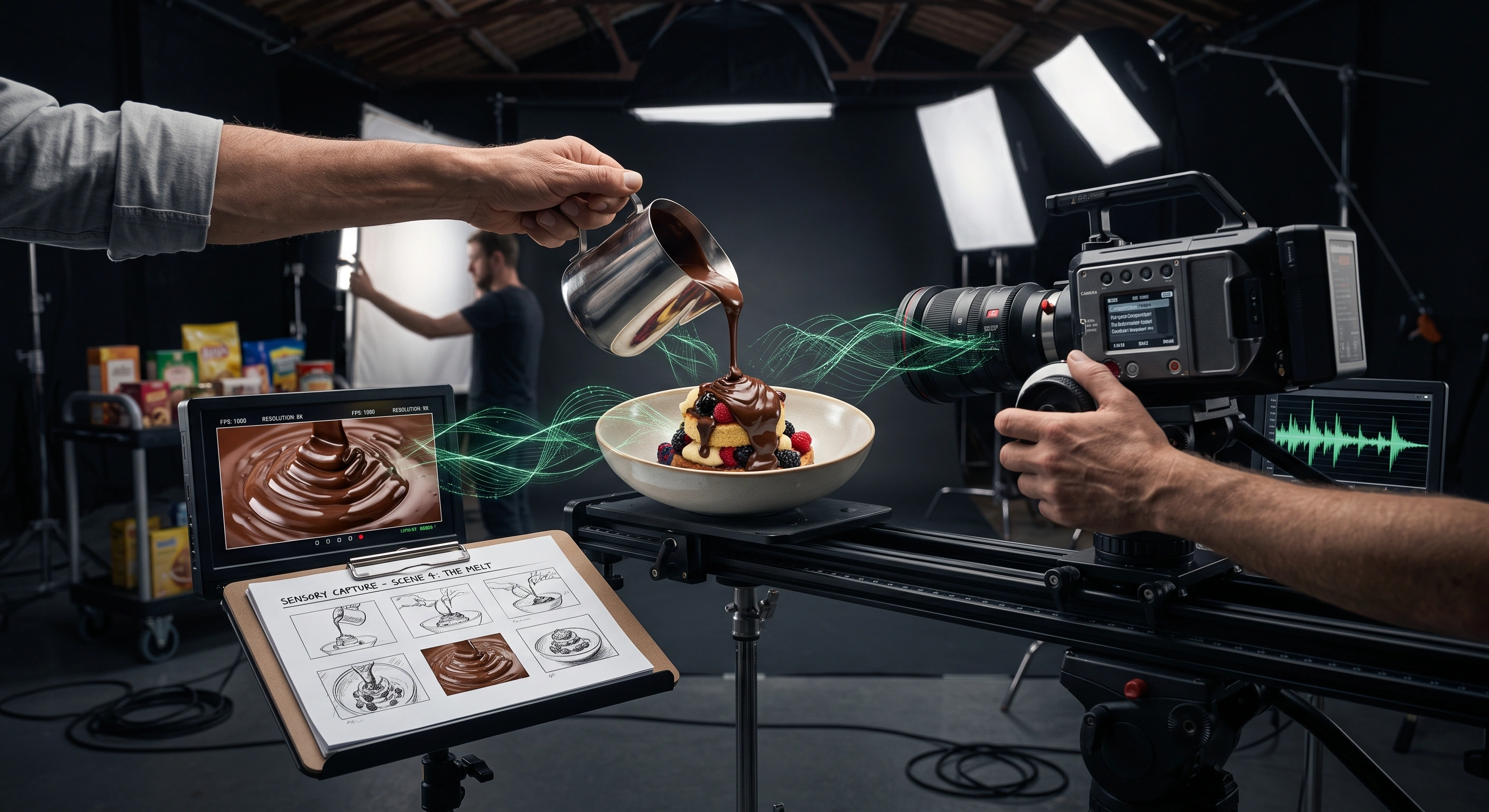
The Anatomy of Effective Video for Food Brands
The crack of a chocolate bar.
A cold drink hitting the inside of a glass.
Steam escaping as a package opens.
A knife cutting through a crisp outer layer.
Thick sauce slowly moving across a plate.
A hand lifting a piece of food just long enough to reveal its texture inside.
Much of the visual language of food video is built from moments like these.
Yet there is an obvious problem: thousands of food videos use the same close-ups, pours, cuts, slow motion and sound effects. Some make us stop, watch and remember. Others disappear from memory almost immediately.
Why?
The answer is not simply better cinematography or more attractive food.
For a food brand, an effective video usually has to do three different jobs:
capture attention, translate the product into a sensory experience, and connect that experience back to the brand.
If only the first happens, the video may generate views without creating brand value.
If the second works but the brand disappears, viewers may remember “a delicious-looking video” without remembering who made the product.
And if the brand dominates while the product itself feels lifeless, the result may be identifiable but unpersuasive.
A 2025 study published in the Journal of Advertising Research, analysing more than 2,300 online video advertisements across food, beverage and restaurant categories, reinforces this point. Food presentation, sensory cues and human interaction did not affect all outcomes in the same way. Different creative elements influenced brand recall, consideration, purchase intention and brand evaluation differently.
There is no universal “viral food video formula”.
The more useful question is:
How can video make food feel more real when the audience cannot actually taste it?
The Fundamental Problem of Food Video: Showing What Cannot Be Tasted
Video delivers image and sound.
Food is experienced through much more:
taste, aroma, texture, temperature, viscosity, moisture, crunch, softness and mouthfeel.
That creates an unusual communication problem.
A viewer cannot bite the product through a screen.
The creative task is therefore to use the senses that are available — sight and sound — to stimulate expectations about the senses that are missing.
A close-up of bread can suggest softness.
The movement of honey can communicate viscosity.
Steam can suggest warmth.
The sound of a chip breaking can communicate crispness more directly than the phrase “extra crunchy” ever could.
This is one reason video has an important advantage over static photography.
Photography can show what food looks like. Video can show how food behaves.
That difference matters.
A food product becomes more tangible when the viewer can see it stretch, melt, crack, pour, bubble, break or change.
1- Movement Should Reveal the Product, Not Merely Decorate the Shot
Why do food advertisements repeatedly use:
pouring, cutting, breaking, squeezing, stirring, opening, melting and stretching?
Because movement can reveal physical properties.
Break chocolate and the interior becomes visible.
Pour a carbonated drink and bubbles communicate effervescence.
Break a biscuit and both the sound and internal structure suggest crispness.
Let a sauce fall from a spoon and its thickness becomes visible.
Stretch cheese and an important product characteristic appears in motion.
The strategic distinction is important:
Movement should communicate something about the food.
A useful test is to remove the movement mentally.
If the viewer learns nothing less about the product, the motion may be decorative rather than informative.
This does not mean decorative movement has no place in advertising. It means product-focused videos should know the difference between:
movement that creates style
and
movement that demonstrates product character.
The strongest work often does both at once.
2- Close-Ups Work When They Reveal Sensory Information
Extreme close-ups are almost synonymous with modern food video.
There is a good reason.
At normal distance, we see a loaf of bread.
Closer, we see:
the crumb structure, moisture, crust, grains and the way the surface breaks.
Those details give the brain more material from which to imagine the eating experience.
Research on digital food imagery has shown that visual proximity can facilitate sensory imagery — helping viewers mentally simulate aspects of taste and consumption.
But close-up photography is not automatically effective.
Magnification is not a strategy.
A close-up earns its place when it reveals something worth seeing:
- crispness,
- layers,
- juiciness,
- melt,
- moisture,
- grain,
- freshness,
- filling,
- or another meaningful characteristic.
If the camera moves closer without adding sensory information, the result is simply a larger image.
3- Sound Can Be as Important as the Image
Now imagine a chip breaking without sound.
Then imagine the same shot accompanied by a clean, sharp crack.
The visual is identical.
The experience is not.
Sound is particularly powerful in food because certain product characteristics are inherently acoustic.
Crispness is heard as well as seen.
Opening a carbonated drink has an identifiable sonic signature.
Frying, grinding, chopping, pouring, bubbling, breaking and stirring each carry information.
Research on eating sounds has shown that making the natural sound of food more salient can influence how the eating experience is evaluated.
The large 2025 analysis of food and beverage advertising also found positive relationships between certain product sounds — such as cracking or crunching — and outcomes including ad recall and product consideration.
This creates an important production question:
Does the product have a sound worth hearing?
If it does, burying that sound under generic music may remove one of the product’s strongest sensory assets.
For some products, sound should not simply accompany the image.
It should be part of the product demonstration.
4- ASMR Is a Sensory Language, Not a Shortcut to Engagement
ASMR-style advertising has become increasingly common.
The term generally refers to highly detailed auditory and visual triggers — tapping, whispering, pouring, cutting, scraping, crunching or other close-miked sounds — that can produce relaxation or heightened sensory attention for some people.
Research suggests that ASMR cues can, under certain conditions, increase immersion and influence advertising responses.
A 2026 study in the Journal of Sensory Studies goes further, suggesting that ASMR-based video advertising can even stimulate olfactory imagery — the mental imagination of smell — although the effect depends on audience involvement and the type of stimulus used.
That sounds promising.
But there is an important complication.
The 2025 analysis of more than 2,300 real-world food advertisements found that not every sensory sound produced positive outcomes. Some ASMR-like elements were associated with weaker results on particular measures.
The lesson is not that ASMR works or does not work.
It is that:
ASMR only works when the sound belongs naturally to the product and the brand.
The crisp break of a biscuit may be an authentic part of the eating experience.
Exaggerated chewing sounds may be completely wrong for a restrained premium brand.
Pouring, sizzling and grinding can feel immersive in one category and irritating in another.
The technique should follow the product.
The product should not be forced into the technique.
5- Slow Motion Is Powerful When Time Reveals Something
Food advertising loves slow motion.
A falling drop.
Sauce folding over itself.
Cocoa powder suspended in the air.
A knife moving through layers.
There is a clear creative advantage: slow motion gives viewers time to see events that would otherwise disappear in a fraction of a second.
But “slower” does not automatically mean “more appetising”.
Research published in 2025 examined slow-motion food video across multiple studies, including social-media settings, and found that its effect depended on context and audience characteristics. One proposed mechanism was increased immersion: slowing the event can make some viewers feel more absorbed in the scene.
The practical lesson is broader than the specific experimental result.
Frame rate should serve the sensory property.
The sudden crack of a shell may be more exciting at natural speed.
The flow of a rich sauce may become more informative when slowed down.
A technique becomes useful when it reveals the product more effectively.
Otherwise it is simply an aesthetic habit.
6- Food Naturally Contains Transformation, Use It as Story
Food is unusually rich in transformation.
Ingredients become dishes.
Beans are ground.
Dough rises.
Chocolate melts.
Coffee brews.
Packaging opens.
A product becomes a meal.
A meal becomes an experience.
That means food brands often have access to narrative without inventing an elaborate story.
Even a 10- or 15-second video can contain:
a beginning,
a change,
and an outcome.
For example:
raw ingredient → preparation → finished texture;
closed pack → opening → consumption;
ingredient → process → product;
problem → product action → result.
Storytelling does not always require a character arc or emotional monologue.
Sometimes:
transformation itself is the narrative.
This is particularly useful in short-form video, where the audience may not give the brand enough time for traditional storytelling.
A clearly visible change can create progression almost instantly.
7- People Engage More When the Product Enters a Recognisable Situation
A product floating in an immaculate studio can look beautiful.
But it exists outside everyday life.
The alternative is not necessarily a complicated lifestyle commercial.
Sometimes a simple context is enough:
- a rushed morning,
- a desk lunch,
- an unexpected guest,
- a post-workout snack,
- a late-night meal,
- a family table,
- a weekend breakfast.
Research into sponsored food video has found that narrative attributes such as relatability, vividness and perceived fit between the person presenting the food and the food itself can support positive emotional responses and viewer engagement.
The strategic implication is important.
Instead of merely telling viewers:
“This product tastes good,”
show where the product belongs.
A useful food video often answers an implicit question:
“When would this make sense in my life?”
The product stops being an isolated object.
It becomes part of a consumption occasion.
8- Human Presence Can Turn Food From an Object Into an Experience
A plate sitting on a table tells us something.
A hand picking up the food tells us more.
A person tasting it adds another layer.
Several people sharing it creates an entirely different meaning.
Human interaction can communicate:
- scale,
- usage,
- social context,
- ritual,
- pleasure,
- and reaction.
The 2025 analysis of food advertising found that human interaction with food was frequently associated with stronger outcomes across measures such as awareness, consideration, purchase intention and brand evaluation.
That does not mean every food video needs a face.
It means people become valuable when they add meaning.
A hand can show texture.
A bite can reveal the interior.
A serving action can explain use.
A shared table can communicate occasion.
By contrast, a model holding a product for no reason adds little.
Human presence should reveal the relationship between the person and the food.
It should not simply decorate the frame.
9- A Delicious Video That Nobody Can Attribute to the Brand Is Incomplete
This is one of the most common failures in food advertising.
The cheese pull looks excellent.
The crunch sounds perfect.
The editing is satisfying.
Viewers watch the entire clip.
Two hours later, they cannot remember which brand made it.
The content succeeded for food appeal.
It did not necessarily succeed for brand building.
Research on brand placement repeatedly shows that brand salience supports memory, while placements that are meaningfully integrated into the content tend to perform better than disconnected brand appearances.
For food video, the solution is not necessarily a giant logo from the first frame.
The stronger approach is to make the brand part of the sensory experience.
The package appears naturally as it opens.
A distinctive product shape becomes part of the action.
A recognisable colour system remains present.
A brand sound or ritual is repeated.
The same pack the consumer will later see on shelf is integrated into the moment of consumption.
The objective is not merely:
“That looked delicious.”
It is:
“That delicious experience belongs to this product.”
Attention without attribution creates weak brand value.
10- Strong Branding Requires More Than a Logo
Imagine that every video from a food brand has:
different lighting,
different music,
different editing,
different camera behaviour,
different colour treatment,
different sound design,
and a different way of presenting the product.
Each video may be attractive.
Together, they may build almost no distinctive memory.
This is where distinctive brand assets become important.
In video, those assets can extend far beyond the logo.
They may include:
- a characteristic way of opening the product;
- a recurring camera movement;
- a sound;
- a serving ritual;
- a recognisable prop;
- a particular interaction;
- a character;
- a rhythm;
- or a distinctive way of showing texture.
Research by organisations such as Ipsos has repeatedly found that distinctive brand assets can strengthen branding in digital advertising, while also demonstrating that not all brand cues perform equally.
The important distinction is:
logo visibility is not the same as brand recognisability.
A strong food brand should consider not only how its videos look, but also how its product repeatedly behaves, sounds and appears on screen.
11- Find the Product’s Sensory Signature
Food brands should not all use the same visual vocabulary.
Not every product needs steam.
Not every video needs a cheese pull.
Not every snack needs exaggerated ASMR.
A better starting question is:
What is the most distinctive sensory characteristic of this product?
For chips, it may be the break and crunch.
For carbonated drinks, the opening, bubbles and pour.
For chocolate, the snap, surface, melt and interior.
For coffee, grinding, pouring, steam, colour and brewing rhythm.
For honey, flow and viscosity.
For frozen food, transformation during preparation.
For spices, colour, dispersal, grinding and the visual transformation of a dish.
For premium agricultural products, it may be texture, hands, harvesting and close observation of the raw ingredient.
Over time, a small set of these cues can become a sensory signature.
Repeated consistently, they may start to belong not simply to the product category, but to the brand itself.
That is far more powerful than chasing whichever food-video technique happens to be fashionable this month.
12- Platform-Native Video Is More Than Cropping a Commercial Vertically
A common workflow still looks like this:
Create a polished 30-second campaign film.
Then cut:
15 seconds,
9 seconds,
a square version,
a vertical version,
and several smaller edits.
This is efficient.
It is not always effective.
A television environment and a short-form vertical feed create different viewing behaviours.
In fast-scrolling environments, the first seconds, framing, pacing, human presence, sound, captions and narrative structure may all need to change.
A useful example comes from Arla Foods and its Cocio brand.
Rather than simply adapting conventional brand advertising for TikTok, the campaign developed videos around the native behaviour and creative language of the platform. TikTok’s own case study reported substantially higher watch time than Cocio’s more traditional ads, alongside gains in ad recall and purchase intent.
Those numbers come from a platform case study and should not be treated as universal benchmarks.
But the strategic lesson is valuable:
Designing for a platform is different from resizing for a platform.
The creative idea itself may need to change.
13- Native-Looking Does Not Mean Careless
The rise of short-form video has also created another misconception:
that content must look unpolished to feel native.
It does not.
A video can be:
professionally lit,
carefully sound-designed,
colour-graded,
scripted,
and strategically edited
while still feeling appropriate for a social environment.
Native content is about matching the communication behaviour of the environment.
It is not about deliberately lowering production standards.
Brands such as Birds Eye and Goodfella’s Pizza have experimented with platform-native executions and creator-led content rather than simply reproducing traditional commercials. Platform case studies have reported positive brand-lift outcomes from these approaches.
The lesson is not “make everything look like user-generated content”.
It is:
Production style and distribution environment should be designed together.
14- The Best Technique Is the One Connected to a Real Product Characteristic
This principle should govern almost everything discussed so far.
Do not break the product because “breaking shots are popular”.
Break it because crispness or structure matters.
Do not use slow motion because it looks cinematic.
Use it because slowing the action reveals something worth seeing.
Do not use ASMR because it is trending.
Use sound because the product has a meaningful auditory character.
Do not use macro photography simply because food videos often use macro photography.
Move closer because the texture contains useful information.
There is a fundamental difference between:
creating video from the product outward and starting with a trend and forcing the product into it.
The first approach can build a recognisable long-term brand language.
The second often produces content that looks like everything else in the category.
15- Sometimes the Product Should Be Quieter
An effective food-content strategy should not lead to the conclusion that every film needs:
macro shots,
crunch sounds,
pouring,
steam,
slow motion,
and visible eating.
Some stories have different jobs.
A brand may want to communicate:
- origin,
- culture,
- people,
- agriculture,
- craft,
- family,
- memory,
- lifestyle,
- or social values.
In those situations, the product may play a quieter role.
Research on narrative and product storytelling suggests that emotional and narrative elements can draw audiences into the world of a story, while excessive commercial intrusion can reduce that immersion.
The strategic question therefore becomes:
What is this video supposed to leave in the viewer’s mind?
Sometimes that answer is product appetite.
Sometimes it is provenance.
Sometimes familiarity.
Sometimes emotion.
Sometimes cultural meaning.
There is no reason every video should optimise for the same outcome.
16- One Video Does Not Need to Do Everything
A frequent creative mistake is expecting a 20-second video to:
introduce the product,
explain the brand,
show the ingredients,
tell the company story,
create emotion,
demonstrate texture,
entertain the audience,
and generate a purchase.
The result often does none of these particularly well.
A stronger content system gives each video a primary job.
One may generate trial interest.
Another may demonstrate texture.
Another may introduce a consumption occasion.
Another may explain an ingredient.
Another may tell the origin story.
Another may launch a new variant.
Another may simply refresh brand memory.
When these pieces belong to one coherent content system, the portfolio can perform multiple functions without requiring every individual video to carry the entire marketing strategy.
17- Do Not Confuse Being Watched With Having an Effect
A food video can attract millions of views.
Important questions still remain.
Did viewers remember the brand?
Did they understand what the product was?
Did the intended product characteristic register?
Did brand perception change?
Did people search for the product?
Did consideration increase?
Did the video simply contain a satisfying visual technique people enjoyed watching?
Tim Hortons’ TikTok work around Loaded Wraps provides a useful case example. The campaign used close product presentation to showcase ingredients and appetite appeal and generated more than 23 million in-feed ad views. But the reported campaign analysis also considered metrics such as ad recall and product association rather than views alone.
That distinction is essential.
Views measure content consumption. They do not automatically measure brand building.
A content team should therefore define success based on the video’s job.
A sensory demonstration may need strong completion and product association.
A launch video may need awareness and search.
A recipe video may need saves, repeat viewing and product-page visits.
A brand story may need different measures again.
The metric should follow the objective.
18- Stop Making Isolated Videos. Build a Video Language.
Food brands rarely need one video.
They need hundreds over time.
New products.
Seasonal content.
Recipes.
Retail media.
Social feeds.
Paid advertising.
Creator collaborations.
Product education.
Brand storytelling.
If every production starts from zero, the brand changes personality every week.
A more mature approach is to build a video language.
That means deciding, for example:
How close do we normally get to the food?
Which sensory characteristics do we repeatedly emphasise?
How important is natural product sound?
How do people interact with the food?
Is the brand rhythm energetic or restrained?
Which movements belong to us?
How should the pack appear?
Which storytelling styles fit the brand?
What should remain recognisable even when the subject matter changes?
These rules are not supposed to eliminate creativity.
They work more like grammar.
A language has rules, but those rules allow people to produce thousands of different sentences.
A brand should not repeat the same video. It should become recognisable across different videos.
That is the difference between content production and content system design.
A 12-Question Test Before Producing Your Next Food Video
Question What it helps you test
1- What is the primary job of this video? Attention, appetite, education, usage, trust or brand memory
2- What is the product’s strongest sensory characteristic? Whether the creative starts with the product
3- What does each food movement reveal? Product demonstration versus decorative motion
4- Does the close-up reveal useful texture or detail? Whether macro imagery has a purpose
5- Is the product’s natural sound worth hearing? Sensory opportunity in sound design
6- Are slow motion or ASMR serving the product or a trend? Technique discipline
7- Does human presence create a believable usage situation? Meaningful lifestyle integration
8- Without the logo, would anything still identify the brand? Distinctive brand assets
9- Will viewers later recognise the same product on shelf? Product continuity
10- Was the video designed for its platform? Platform-native execution
11- Are we measuring more than views? Brand and behavioural impact
12- Do ten videos from this brand feel like one system? Long-term creative consistency
Effective Food Video Makes Something Feelable
Perhaps this is the simplest way to define the goal.
A good food video should not merely demonstrate that the brand has a capable content team.
It should communicate something about the product that the screen would otherwise make difficult to experience.
Make crispness audible.
Make texture visible.
Make viscosity visible through movement.
Make freshness imaginable.
Make the consumption occasion recognisable.
Make the product feel closer.
And then connect that experience to the correct brand.
The camera, lighting, editing, slow motion, sensory sound, creators, platform formats and even artificial intelligence are all tools.
None of them is the strategy.
The strategy begins with a more fundamental question:
What is worth feeling about this product — and how can video bring that sensation closer without letting the audience taste it?
Once that question has a clear answer, the choice of technique becomes much easier.
That may be the difference between ordinary food video and memorable food video.
Ordinary video shows the food.
Effective video makes viewers feel, briefly, as though they have experienced it.
And effective branded video does one more thing:
when that feeling ends, viewers know which product — and which brand — created it.
Sources
- Elder, Slejko, Dotson & Pol, Designing Delicious: An Examination of Creative Attributes Driving Food, Beverage, and Restaurant Advertising Effectiveness, Journal of Advertising Research, 2025 — analysis of more than 2,300 online food, beverage and restaurant video advertisements and the relationship between sensory, food and human cues and advertising outcomes.
- Kaya & Oyman, Imagined Scents and Enhanced Engagement in ASMR Video Ads Under Varying Involvement Conditions, Journal of Sensory Studies, 2026 — research into ASMR advertising, olfactory imagery and consumer involvement.
- De Kerpel, Van Kerckhove & Tessitore, research published in the International Journal of Advertising on ASMR cues, relaxation, immersion and purchase intention.
- Huang, Yang, Lian & Wu, Slow Motion, Fast Impact: Enhancing Food Video Marketing with Cinematic Techniques, 2025 — multi-study research on slow-motion food video and viewer immersion.
- Elshazly, Yan & Ghaith, research in the Journal of Retailing and Consumer Services, 2025 — examining narrative attributes, emotional response and engagement in sponsored food video.
- Liu, Wu, Yu & Huang, research in the Journal of Business Research on sensory imagery in online food presentation and the influence of visual characteristics on freshness, taste imagination and purchase response.
- Research in Appetite on the salience of food sounds and their role in consumption and sensory evaluation.
- Meta-analytic research in the International Journal of Research in Marketing on brand placement, brand memory and the importance of meaningful integration between brands and narrative.