
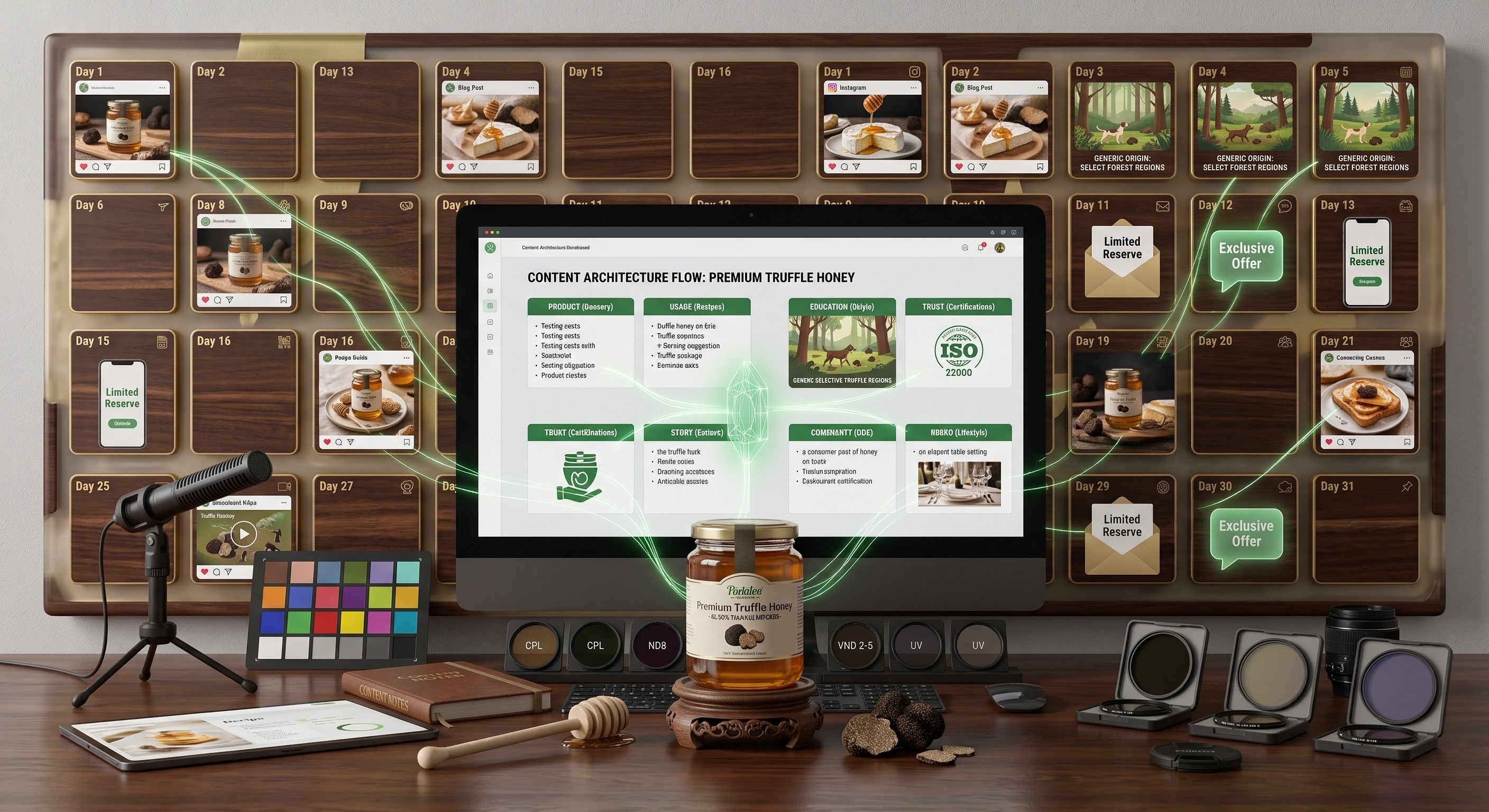
A Practical Framework for Building a Content Architecture Before the Calendar, Reels and Campaigns
Many food brands have a content calendar.
- Monday: product post.
- Tuesday: seasonal occasion.
- Wednesday: recipe.
- Thursday: behind the scenes.
- Friday: educational tip.
And when the calendar starts to look empty, a quote, giveaway or topical post fills the gap.
The schedule looks organised.
Content is published consistently.
But ask a more difficult question:
Why do these pieces of content belong together?
The answer is often less clear.
One post is supposed to generate sales.
Another is designed for engagement.
Another explains the product.
Another tries to build trust.
And some exist mainly because “we have not posted for a few days”.
A brand can therefore publish continuously for a year without building much cumulative knowledge, meaning or memory around itself.
The problem is not necessarily a shortage of content.
The deeper problem is:
The brand has not defined what its content is supposed to do.
This is where content architecture becomes useful.
A content calendar answers:
What should we publish, when and on which channel?
Content architecture asks the questions that should come first:
What should we talk about? Why does it matter? Who is it for? What evidence supports it? And what role should each content category play?
There is no universal formula for every food brand.
The content system for a snack brand should not look identical to one for baby food, specialty coffee, premium olive oil or export-grade saffron.
But by combining evidence from food communication, storytelling, authenticity research, branded content, user-generated content and current industry practice, we can build a more defensible framework for deciding what a food brand should talk about before deciding how often it should post.
First, Clarify What a “Content Pillar” Actually Is
Content strategies often define pillars such as:
product,
education,
entertainment,
behind the scenes,
seasonal content.
That is not necessarily wrong.
But these categories often mix different things.
Some are topics.
Some are objectives.
Some are formats.
Some are simply publishing occasions.
For example, “behind the scenes” does not tell us why the content exists.
Is the purpose to:
- demonstrate quality control?
- humanise the brand?
- show transparency?
- build employer reputation?
- or simply entertain?
The same behind-the-scenes video can perform very different strategic functions depending on the reason it was made.
A more useful definition may be:
A content pillar is a durable area of communication value that the brand chooses to build over time.
Within each pillar, the team can then create:
- different topics,
- messages,
- formats,
- platform executions,
- and campaigns.
- This keeps format from becoming strategy.
Food Content Does Not Have One Job
Food is not simply a product category.
It can also be:
a daily necessity,
a sensory experience,
part of personal health,
a cultural signal,
a family ritual,
a source of pleasure,
a social activity,
a gift,
or part of someone’s identity.
That is why food content can serve very different functions.
Sometimes it needs to create appetite.
Sometimes reduce uncertainty.
Sometimes help people use a product.
Sometimes substantiate a claim.
Sometimes explain origin.
Sometimes create cultural meaning.
Sometimes simply make the brand more familiar in everyday life.
A 2024 study analysing 442 social-media posts about food and nutrition found that practical and informational content did not perform identically across platforms. In that sample, practical content generated particularly strong reach and engagement on Instagram, while Facebook showed a different pattern.
That research was conducted in a nutrition-education context, so it should not be treated as a universal rule for commercial food brands.
But it supports a useful principle:
The value a piece of content provides and the environment in which it is delivered both matter.
So a better starting point is not “What formats should we make?”
It is:
What jobs should our content perform?
A Proposed Framework: Seven Content Territories for Food Brands
The seven territories below are not an industry standard.
They are a practical model.
A brand may emphasise some heavily, use others selectively and ignore some almost entirely.
The right mix depends on:
the product,
the market,
the audience,
the category,
and the brand position.
1- Product: What Exactly Are We Selling?
This sounds obvious.
It is often underdeveloped.
Brands know their own products so well that they sometimes forget the customer does not share the same internal knowledge.
Product content can answer questions such as:
- What is this product?
- How is it different from the alternative?
- Which flavours or variants exist?
- Why is this format or pack size useful?
- What is the texture like?
- What is the key product characteristic?
- When is it intended to be used?
- Which variant is more suitable for which need?
The important distinction is that product content should not simply repeat the front of the pack.
If every product post says:
- premium, delicious, high quality, different, exceptional
- the audience has learned very little.
- A coffee brand, for example, might explain:
- the roast level,
- the expected flavour profile,
- and the brewing methods that suit the product.
A sauce brand may help customers understand the difference between two similar variants.
A yoghurt brand may explain texture, protein content or usage occasions — provided nutritional claims are accurate and appropriate for the relevant market.
The role of product content is to turn the product from something visible into something understandable.
2- Usage and Consumption Occasions: What Can I Do With This Product?
For many food brands, this can be one of the highest-value content territories.
But it should not be reduced to “post more recipes”.
Usage content can answer:
- When would I use this?
- What can I pair it with?
- Which meal or occasion does it suit?
- What else can I make with it?
- Can it save time?
- What does it combine well with?
- Can it create a new consumption occasion?
Content can expand how a product fits into someone’s life without changing the product itself.
For example:
A cheese brand can move beyond breakfast and show use in salads, sandwiches or cooking.
A spice brand can show how different dishes change when the spice is used differently.
A coffee brand can show alternative brewing methods or consumption moments.
Commercial platform guidance in food and beverage increasingly reflects this wider view. TikTok’s 2025 food and beverage playbook, for example, highlights not only recipes but also supply chain, food science, taste testing and food culture.
That is platform guidance, not academic evidence that every format will work universally.
But it illustrates an important industry pattern:
Food content becomes more useful when it extends what people can do with the product.
The purpose is not to fill the calendar.
It is to increase product usefulness and relevance.
3- Education: Help People Choose and Understand Better
Some food brands can credibly teach people about the category.
Examples might include:
- What is the difference between extra virgin and regular olive oil?
- What does roast level mean in coffee?
- How do different flours behave?
- How should spices be stored?
- What should people look for on a product label?
- What does a technical term actually mean?
This type of content can move the brand from being only a seller toward becoming a useful source of category knowledge.
But there is an important boundary.
Educational content is not permission to make unsupported claims.
The risk increases when content touches:
- health,
- nutrition,
- diet,
- allergens,
- children,
- disease,
- or physiological effects.
Educational content can look neutral even though it is still part of a commercial brand’s communications.
Research and regulatory discussion around digital food information increasingly recognise the difficulty of separating education, influence and promotion online.
A useful operating principle is:
The more a piece of educational content can affect health or safety decisions, the stronger the scientific and legal review should become.
That does not make educational content undesirable.
It makes evidence discipline more important.
4- Proof and Trust: Why Should Anyone Believe the Brand?
This territory is different from product promotion.
A brand can say:
- natural,
- premium,
- authentic,
- responsibly sourced,
- locally produced,
- high quality.
The customer may reasonably ask:
Based on what?
Proof-oriented content can include:
- ingredient sourcing,
- certifications,
- production methods,
- testing,
- quality-control processes,
- standards,
- claim definitions,
- ingredient transparency,
- or supply-chain information.
Not all of this content needs to be highly emotional.
Sometimes a clear document, a real photograph, a transparent explanation or a simple piece of evidence may do more for trust than a cinematic film.
Recent research on authenticity also suggests a more nuanced view than “authentic brands always receive a reward”.
A 2026 study involving three experiments and 1,617 participants found that authentic brands performed better than inauthentic brands, but did not necessarily outperform a neutral condition in every case.
One interpretation is that authenticity may function less like an exceptional bonus and more like a minimum expectation: brands may be penalised when authenticity is missing rather than rewarded every time it is present.
For content teams, that distinction matters.
The objective is not necessarily to announce:
“Look how authentic and transparent we are.”
A stronger approach may be to make verifiability and consistency part of the normal communication standard.
Trust is rarely built by claiming trustworthiness. It is built through things people can inspect.
5- Origin, People and Culture: Where Did This Product Come From, and Why Does It Matter?
Food has an unusually strong relationship with:
- place,
- family,
- culture,
- agriculture,
- tradition,
- local practice,
- history,
- and people.
That gives food brands significant storytelling potential.
But only when there is something real to tell.
A 2026 study in the International Journal of Hospitality Management used five studies, including field and experimental work, to examine storytelling around food experiences. The research found that storytelling could increase consumption intention through perceived authenticity and meaningfulness.
The context was mainly hospitality and food experience rather than packaged FMCG, so the effect should not be automatically generalised to every food brand.
But it provides a reasonable basis for exploring storytelling when the brand genuinely has:
- origin,
- cultural context,
- people,
- craft,
- or place-based meaning.
Earlier research on ethnic food has also found that origin stories can influence perceived authenticity and purchase intention.
The risk is equally important.
If every ordinary product is surrounded by language such as:
“centuries of tradition”,
“a secret family recipe”,
“farmers with a lifelong passion”,
or
“unchanged for generations”,
storytelling quickly becomes generic theatre.
Research on brand storytelling also suggests that perceived authenticity matters and that product type and price context can affect audience response.
A useful rule is:
Strong stories are extracted from brand reality. Brand reality should not be altered to create a better story.
6- Community and Consumer Experience: How Do Other People Use the Product?
Modern content architecture cannot assume that the brand controls every voice.
Consumers:
- review,
- photograph,
- compare,
- criticise,
- share recipes,
- and create their own interpretations.
But one popular assumption deserves caution:
“User-generated content is always more authentic and more effective.”
The evidence is not that simple.
A 2025 study in online food purchasing compared advertising, firm-generated content and user-generated content. In that sample, firm-generated content showed a significant relationship with purchase propensity, while user-generated content did not show a significant direct effect.
The authors themselves noted the contextual limitations.
A separate 2025 study involving 860 hospitality consumers found that both brand-generated and consumer-generated food photography could be associated with perceived authenticity and brand impressions, while their relationships with digital engagement differed and online community influence also mattered.
The implication is not that UGC is ineffective.
It is that:
UGC should be treated as one component of the content system, not as an automatic trust engine.
Community content can be valuable for:
- social proof,
- showing real consumption occasions,
- feedback,
- participation,
- inspiration,
- and humanising the brand.
But brands do not need to repost everything consumers create.
Curation matters.
The goal should be to amplify experiences that are consistent with the product truth and the brand position.
7- Brand World: What Kind of Life, Culture or Feeling Does the Product Belong To?
This is where content moves furthest away from product specification.
The brand begins to communicate around the world in which the product makes sense.
That world might involve:
- family,
- sport,
- music,
- travel,
- humour,
- food culture,
- creativity,
- social occasions,
- or everyday routines.
Some brands derive a substantial part of their identity from this territory.
A beverage may communicate more about social occasions than its ingredient list.
A snack brand may participate in youth culture or entertainment.
Coffee may become part of a ritual around work, conversation or creativity.
But this is also the easiest territory to abuse.
A brand that reacts to every:
- meme,
- trend,
- holiday,
- or cultural moment
may generate visibility while gradually losing strategic meaning.
A useful test is:
If the brand name disappeared from the content, would the subject still belong recognisably to this brand’s world?
If the answer is no, the brand may simply be producing topical content rather than building a distinctive cultural territory.
The Seven Territories Should Not Receive Equal Weight
This is one of the most important principles in content architecture.
Architecture is about selection.
It is not about discovering seven pillars and then publishing one post from each every week.
For a mainstream snack brand, the system may lean more heavily toward:
- product desire,
- usage moments,
- culture,
- entertainment,
- and community.
For specialty coffee, the centre of gravity may be:
- education,
- origin,
- brewing,
- product knowledge,
- and people.
For baby food or products with sensitive nutrition considerations, the system may need far greater emphasis on:
- clarity,
- evidence,
- ingredient information,
- scientific review,
- and trust.
For premium saffron or geographically distinctive foods, the strongest territories may be:
- origin,
- authenticity,
- culture,
- proof,
- usage,
- and quality.
So the recommendation should not be:
“Every food brand needs seven content pillars.”
A more defensible statement is:
A food brand should decide which of these territories are genuinely strategic for its category, audience and position.
Product Involvement Should Affect Content Depth
Not every food purchase requires the same amount of explanation.
A familiar soft drink may be chosen in seconds.
A customer considering:
- baby food,
- gluten-free products,
- specialty coffee,
- premium olive oil,
- functional foods,
- or unfamiliar ingredients
may need substantially more information.
Research on food influencers also illustrates how content is processed differently depending on the information context.
A 2024 experiment involving 197 participants found that the effect of influencer follower count depended on whether the content was primarily entertaining or informational. In that study, larger follower counts mattered more for entertaining content, while smaller influencers could perform similarly to larger ones in informational contexts.
That is a limited experiment, not a universal influencer rule.
But it reinforces a broader point:
Audiences do not process all content in the same way.
Content architecture should therefore ask:
How much explanation does this product actually need?
There is little value in producing highly technical educational content around a simple chocolate bar merely because “education” sounds strategically sophisticated.
Depth should follow genuine customer uncertainty.
Build Content Around Audience Questions, Not Only Brand Topics
Imagine a honey brand.
Internally, the company may want to talk about:
- its history,
- factory,
- packaging,
- awards,
- and product range.
The audience may be asking:
- What is the difference between these honeys?
- Where does this variety come from?
- How should honey be stored?
- Does crystallisation mean the product has gone bad?
- What can I use it for?
- How is the origin claim verified?
This leads to a useful principle:
Content architecture should sit at the intersection of three things:
what the brand wants to say
what the audience genuinely wants or needs to know
what the brand has the evidence and legitimacy to say
Remove any one of the three and the system weakens.
Only brand agenda → self-centred advertising.
Only audience demand → generic media with little brand advantage.
Only verified facts → technically correct but possibly unengaging documentation.
Strong architecture balances all three.
Promotion Is Better Treated as an Activation Layer, Not a Content Pillar
- New product launch.
- Discount.
- Giveaway.
- Retail activation.
- Trade show.
- Seasonal campaign.
- Store opening.
- All of these matter.
But it is useful to treat them as activation moments layered on top of the architecture rather than as a permanent pillar equal to the others.
Why?
Because a launch can draw on several territories at once:
product,
usage,
proof,
story,
community.
If “promotion” becomes a standalone pillar, the content calendar can gradually become dominated by short-term commercial activity.
A stronger system allows campaigns to use the content architecture.
The architecture should not exist simply to fill the weeks between campaigns.
Do Not Confuse Format With Content Strategy
A Reel is not a pillar.
An article is not a pillar.
A podcast is not a pillar.
An infographic is not a pillar.
Photography is not a pillar.
These are containers.
The subject “coffee origin” might become:
a long-form article,
a short vertical video,
an interview with a producer,
a map,
a photo essay,
a Q&A,
or creator content.
If the process begins with:
“We need three Reels this week. What should they be about?”
production has begun to dictate strategy.
A more mature sequence is:
What needs to be communicated? → What format communicates it best?
That distinction becomes more important as content production gets easier.
Content Source Is Also Part of the Architecture
Not every message needs to come directly from the brand account.
A content system may involve:
The Brand
For official product information, process, standards and corporate position.
Experts
For subjects requiring professional knowledge.
Employees and Producers
For process, people and real operational context.
Consumers
For everyday experience and social proof.
Creators
For translating the product into the language of a particular audience or community.
But different voices carry different responsibilities.
Especially in food, using a creator or expert does not transfer responsibility for claims away from the brand.
The U.S. Federal Trade Commission requires material connections between brands and endorsers to be clearly disclosed. Brands are also expected to take reasonable steps to guide and monitor claims made by people working on their behalf.
So:
“Let someone else say it” does not mean “the claim is no longer our responsibility”.
Governance needs to travel with the content.
Does Every Piece of Food Content Need a “Reason to Believe”?
No.
A humorous snack video does not need a scientific citation.
But whenever content makes a factual claim, the team should know what supports it.
That can be operationalised.
For important claims, record:
- What exactly is the claim?
- What supports it?
- Who approved it?
- For which market is it valid?
- When should it be reviewed?
- Which wording is permitted?
- Where has it been used?
For example:
- “Contains 20 g of protein per serving”
- is very different from:
- “supports a healthy lifestyle”
- which is different again from:
- “the best choice for athletes”.
One measurable fact does not automatically validate the broader claims surrounding it.
Regulators such as the FTC consistently emphasise that objective advertising claims should be truthful, non-misleading and appropriately substantiated.
That is what a real reason to believe should mean.
Not another advertising slogan.
A reason to believe is the internal answer to:
Why are we allowed to say this?
Food Content Needs Governance, Not Only Creativity
When a brand publishes 50 pieces of content a year, oversight is relatively simple.
When it grows into:
- multiple markets,
- multiple languages,
- hundreds of products,
- dozens of creators,
- and thousands of digital assets,
- the problem changes.
Old content may:
- show outdated packaging,
- contain obsolete claims,
- reference expired certifications,
- use old nutrition information,
- or promote discontinued products.
Content architecture therefore needs to consider the content lifecycle:
create → review → approve → publish → reuse → update → retire
This is especially important in food because content is often connected to regulated product information.
A strong content system needs a mechanism for knowing when something is no longer safe or accurate to reuse.
Children, Health and Nutrition Require a Higher-Control Path
Not all food content carries the same risk.
Content involving:
- children,
- health,
- weight management,
- nutrition,
- allergens,
- or functional claims
requires a higher standard of review.
WHO has continued to raise concerns about digital food marketing to children and its influence on dietary behaviour.
Regulators such as the FTC also treat advertising directed toward children as an area requiring particular caution.
So the content team cannot rely only on:
“Will this get engagement?”
More important questions may include:
- Is the audience appropriate?
- Could the message be misunderstood?
- Is the claim supported?
- Is sponsorship disclosed?
- Is the expert actually qualified?
- Is the content likely to encourage an inference the evidence does not support?
In higher-risk categories, the approval process should become more rigorous.
Treat Important Content as Managed Assets, Not Just Files
This is more operational, but increasingly important.
Imagine a major product article.
If everything exists only inside the finished article, it becomes difficult to manage later.
Behind important content, it can be useful to store structured information such as:
- topic,
- related product,
- content territory,
- market,
- audience,
- claims used,
- claim sources,
- last review date,
- content owner,
- related media,
- image rights,
- and review or expiry status.
Then content is no longer simply:
- a file
- It becomes:
- a managed brand asset.
- This becomes even more relevant as AI accelerates content production.
- If the architecture is weak, AI does not fix the problem.
- It simply helps the team produce inconsistent content faster.
AI Does Not Solve “What Should We Talk About?”
A generative model can produce:
- 100 content ideas,
- 50 captions,
- 30 article headlines,
- 10 video scripts
- in seconds.
That is not the same as content strategy.
Ask an AI system:
“Give me 100 ideas for our food brand”
and it probably will.
The strategic problem is:
Which five should actually be made?
AI is powerful at expanding the option set.
Content architecture exists to narrow the option set.
This may become one of the most important responsibilities of content teams in the AI era:
not producing more, but choosing better.
Different Content Roles Need Different Metrics
Another common mistake is evaluating every content type through:
likes,
views,
engagement,
or immediate sales.
If content performs different jobs, its success indicators should differ too.
| Content role | Possible indicators |
|---|---|
| Product understanding | Product-page visits, branded search, correct product discovery, retailer clicks |
| Usage and recipes | Saves, return visits, completion, recipe search, movement to product pages |
| Education | Reading depth, search visibility, related-content consumption, reduction in repeated questions |
| Proof and trust | Certification-page visits, evidence engagement, brand-research measures |
| Story and culture | Recall, association with intended brand meaning, video completion |
| Community | Participation, quality of discussion, relevant submissions, creator activity |
| Commercial activation | Sales, retailer clicks, conversion, trial, consideration |
This is not a universal measurement formula.
For example, time on page does not prove that someone learned something.
A like does not prove that brand memory improved.
The purpose of the framework is to ask:
If this content performed its job successfully, what change would we expect to observe?
Metrics should follow the role.
One Universal KPI Can Distort the Entire System
Suppose engagement becomes the only measure.
The team quickly learns what gets rewarded.
More humour.
More trends.
More giveaways.
More easy questions.
More provocative posts.
Because those things can generate interaction.
Meanwhile:
certification content,
origin explanation,
technical education,
or clear product comparisons
may receive fewer likes.
Should they disappear?
Not necessarily.
If they perform different jobs, they require different evaluation.
This is why content architecture should be designed before the measurement dashboard.
Otherwise, whatever the platform measures most easily gradually becomes what the organisation considers most important.
Think in Terms of a Content Portfolio, Not Only a Content Calendar
The word portfolio is useful here.
A food brand may produce in one month:
ten lightweight pieces,
three educational assets,
two proof-oriented pieces,
one deeper story,
several usage posts,
and some community content.
They do not all have equal strategic value.
They do not cost the same.
They do not have the same lifespan.
A meme may last two days.
A strong guide may remain valuable for three years.
An origin film may be reused repeatedly.
A product transparency page may need continuous updates.
So the more useful question is not:
How many pieces did we publish this week?
It is:
What kind of content assets is our portfolio building for the brand?
That shift changes how teams think about both effort and value.
Four Examples of Different Food Content Architectures
Everyday Snack Brand
Likely to emphasise:
product desire,
sensory experience,
consumption occasions,
culture,
entertainment,
and community.
Deep education may play a smaller role.
Specialty Coffee Brand
May lean more heavily on:
product knowledge,
origin,
education,
brewing,
coffee culture,
and people across the value chain.
Some commercial examples, such as Golden Brown Coffee, suggest that combining educational and entertaining coffee content can build a substantial audience. That remains a platform case study, not proof that the same approach will work for every coffee brand.
Baby or Sensitive-Nutrition Brand
May require greater emphasis on:
- clarity,
- ingredients,
- evidence,
- safety,
- accurate information,
- expert review,
- and trust.
Entertainment and creator work may still be relevant, but claims control becomes much more important.
Premium Origin-Led Food Brand
For example, saffron, olive oil or geographically distinctive products.
Its architecture may centre on:
- origin,
- culture,
- production,
- authenticity,
- quality evidence,
- usage,
- and people.
Here, storytelling is not simply emotional decoration.
It can help customers understand why this product is different from another one.
An Eight-Step Process for Building a Food Content Architecture
If the framework needs to become operational, a practical process may look like this.
1-Document Product Truth
- What is the product?
- What are its real characteristics?
- Which claims are valid?
- Which claims are not?
2- Define Priority Audiences
- End consumer?
- Parent?
- Athlete?
- Retail buyer?
- Chef?
- Importer?
- Not every audience needs the same level of content investment.
3- Collect Real Audience Questions
Use:
- site search,
- social comments,
- sales teams,
- customer service,
- retailer feedback,
- consumer reviews,
- and market research.
4- Clarify the Brand Position
- What do we want to be known for?
If that answer is vague, the content architecture will usually become broad and generic.
5- Select the Strategic Territories
From the seven proposed territories:
- product,
- usage,
- education,
- proof,
- origin and story,
- community,
- brand world,
which ones actually matter?
6- Define the Reason Each Territory Exists
For example:
Education → reduce uncertainty in a complex category.
Origin → support meaningful differentiation.
Recipes → increase consumption occasions.
Community → show real product experience.
7- Define Evidence and Ownership
- Who approves each claim?
- What source supports it?
- When should it be reviewed?
8- Only Then Build the Calendar and Formats
Now decide whether the message needs:
- an article,
- video,
- photo,
- short-form social content,
- creator collaboration,
- email,
- product-page content,
- or something else.
Not before.
Food Brand Content Architecture Checklist
Before building the next quarterly calendar, ask:
1- Does each content territory have a clearly defined job?
2- Were the territories chosen for this brand, or copied from a generic template?
3- Does our content help people actually understand the product?
4- Does it create useful consumption occasions?
5- Is educational content genuinely educational, or disguised promotion?
6- Do important claims have a defensible reason to believe?
7- Are brand stories grounded in reality?
8- Do we curate community content intentionally?
9- If trends disappeared tomorrow, would the brand still have a recognisable content world?
10- Do different products receive different levels of content depth?
11- Do we choose format based on the message rather than the production schedule?
12- Is ownership of accuracy and updating clearly assigned?
13- Do we review or retire outdated content?
14- Are metrics aligned with the role of each content type?
15- If we place one year of content side by side, does it build one coherent picture of the brand?
The fifteenth question may be the most important.
Content Should Not Only Be Published. It Should Accumulate Meaning.
A post can perform well today and disappear tomorrow.
A Reel can generate engagement without building much brand memory.
An article can rank in search without strengthening the product.
Professional content strategy therefore cannot be judged only by the quality of individual pieces.
The system needs to be evaluated over time.
Has a year of content:
made the product easier to understand?
created more ways to use it?
strengthened trust?
built useful category knowledge?
clarified the brand’s origin and personality?
brought people into meaningful participation?
created a recognisable world around the brand?
If yes, content has become more than media activity.
It has become a brand asset.
That is why the best question at the beginning of a content programme is probably not:
“What should we post this month?”
It is:
“If someone encounters our content repeatedly over the next year, what should they eventually know, believe and remember about our product, our brand and the world around it?”
Only after answering that should the team decide on:
- the calendar,
- Reels,
- articles,
- photography,
- AI,
- creators,
- campaigns,
- or platforms.
Because architecture should come before production.
And in the long term, what may distinguish one food brand from another is not how much content it publishes.
It is:
what it chooses to talk about, why it has the right to talk about it, and how consistently those messages build on one another.
Sources
- Avelino et al. — Assessing the Reach and Engagement Effectiveness of Disseminating Food and Nutrition Information on Social Media Channels, Foods, 2024.
- Analysis of 442 posts examining differences in performance across practical, informational and other content types on Instagram and Facebook.
- Huang et al. — From Kitchen to Mind: The Effect of Storytelling on Meaningfulness and Food Consumption Intention, International Journal of Hospitality Management, 2026.
- Five studies examining food storytelling, perceived authenticity, meaningfulness and consumption intention.
- Yin et al. — Telling an Authentic Story by Aligning With Your Product Type and Price, Journal of Business Research, 2023.
- Research on authenticity in brand storytelling and the moderating role of product type and price.
- Research in the Journal of Retailing and Consumer Services — Is Authenticity Rewarded or Inauthenticity Penalized?, 2026.
- Three experiments involving 1,617 participants, supporting a more nuanced interpretation of how authenticity affects consumer response.
- Vasan, Rao & Gupta — research in Future Business Journal, 2025.
- Study comparing advertising, firm-generated content and user-generated content in online food purchasing.
- Sohaib & Safeer — research in the Journal of Hospitality and Tourism Technology, 2025.
- Study of 860 consumers examining food imagery, source, authenticity, brand perceptions and online community effects.
- Misra et al. — research in the British Food Journal, 2024.
- Experimental work on food influencers, follower count and the interaction between informational and entertaining content.
- U.S. Federal Trade Commission — Endorsement Guides, Disclosures 101 and advertising substantiation guidance.
- Referenced for clear disclosure of commercial relationships and the need for objective claims to be truthful, non-misleading and appropriately substantiated.
- World Health Organization — 2025 guidance and expert discussion on digital food marketing to children.
- Referenced for the higher level of caution required in child-directed food communication.
- TikTok for Business — Food & Beverage Playbook, 2025.
- Used as an example of current platform practice around recipes, food science, supply-chain storytelling, taste testing and food culture; treated as commercial guidance rather than academic evidence.