
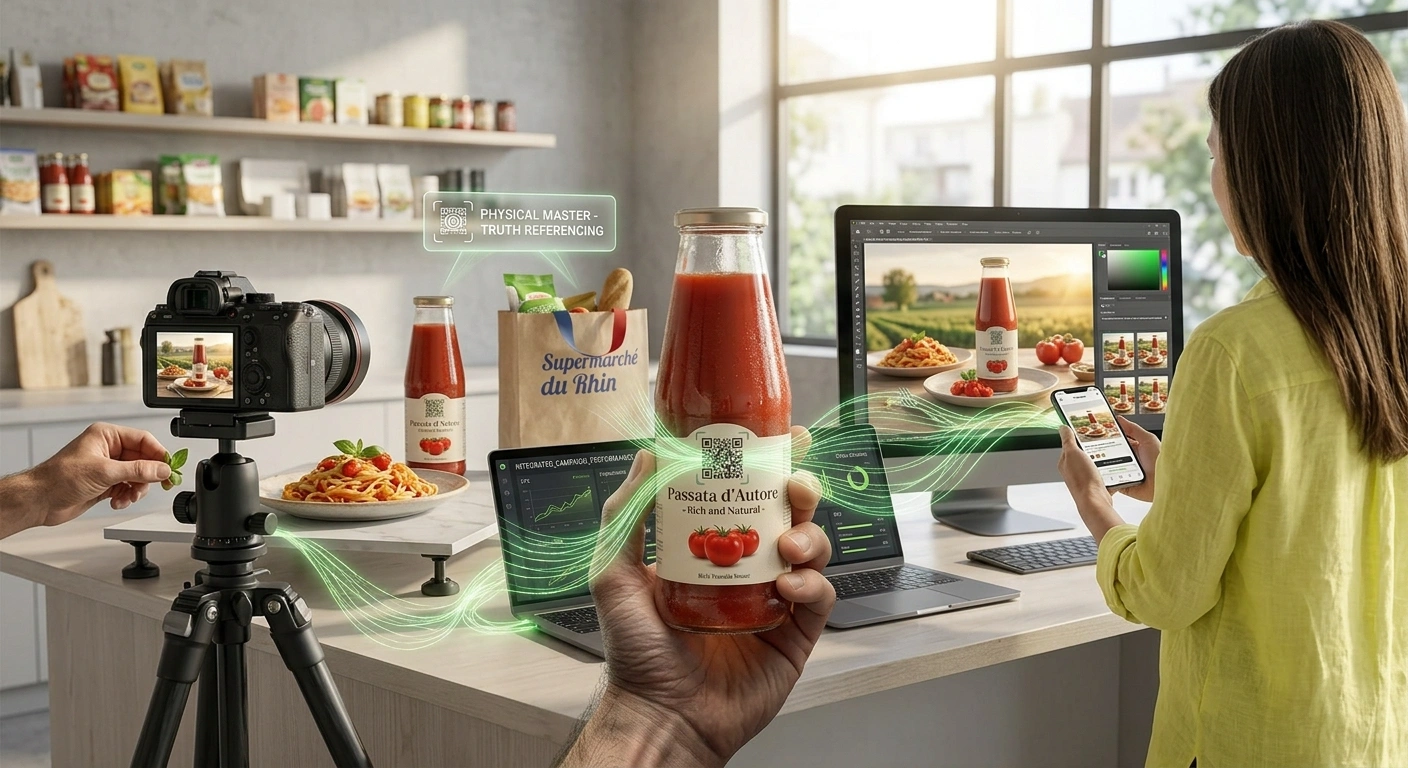
A food brand is preparing to launch a new product.
It needs a hero image for the website, product visuals for social media, retailer assets, seasonal campaign variations, perhaps different executions for several markets, and dozens of additional formats.
Until recently, the production model was relatively straightforward: prepare the product, build the set, bring in a photographer and food stylist, shoot the required material, then adapt it for different channels.
Today, the obvious question is different:
Why not generate most of it with AI?
Generative image tools can create an immaculate breakfast table, a golden-hour farm, a premium kitchen, a summer picnic or an entire campaign world within minutes. Many of these scenes never need to physically exist.
For food brands, however, the important question is not simply:
Photography or AI?
A more useful question is:
Which parts of an image need to communicate product truth — and which parts are free to communicate imagination?
That distinction is increasingly important.
Because in food, an image does more than create a mood.
It can shape expectations about what the product will actually taste, feel and look like.
Food Imagery Is Not Just Visual Communication. It Is a Sensory Promise.
Consumers cannot smell, touch or taste a product through a screen.
They infer those qualities visually.
The gloss on a sauce can suggest richness.
Steam can communicate warmth and freshness.
A close-up of bread can imply softness or crispness.
The colour and surface of fruit can suggest ripeness.
The thickness of a filling can imply indulgence.
Even background elements can change what people believe about a food.
Research in Food Quality and Preference, for example, has shown that visual cues such as animated steam can increase perceived temperature and, under some conditions, perceived freshness and desirability.
Other research has found that natural imagery surrounding food can create health-related associations and influence attitudes toward the product.
That matters enormously when AI enters the production process.
Imagine that the actual package remains untouched, but AI places it among fresh leaves, harvested fruit, morning dew and a sunlit farm.
No explicit “natural” claim has been written.
Yet the image may still communicate:
freshness,
naturalness,
minimal processing,
or proximity to agriculture.
So in food marketing, changing the image can also change the meaning of the product.
The Real Question Is Not Whether an Image Is “Fake”
The growing body of research on AI-generated food imagery does not support a simple conclusion such as:
“Real photography always performs better.”
The picture is more complicated.
A 2024 study by Califano and Spence found that, when viewers were not told how the images had been produced, AI-generated food imagery was often rated as highly appealing and in some cases more appealing than real food photography.
But source disclosure changed perception.
When participants were told that an image was real, its appeal increased. When they were told that an image was AI-generated, some of that advantage disappeared.
A 2025 study involving 154 participants and five food categories produced another important finding: AI-generated images could sometimes outperform photographs visually, but the more strongly people believed an image was AI-generated, the lower their perceptions of naturalness and willingness to eat tended to become.
A 2026 British Food Journal study involving 241 consumers also found differences between responses to labelled real and AI-generated food images, including lower perceived value and greater negative word-of-mouth intentions in the AI-image condition.
The important conclusion is therefore not:
AI imagery cannot work.
It clearly can.
The stronger conclusion is:
Visual appeal and product credibility are not the same thing.
A food image can be highly attractive while simultaneously increasing the distance between what the customer expects and what the product actually delivers.
That is the tension brands need to manage.
A Better Decision Tool: How Much “Truth Load” Does the Image Carry?
One practical way to decide whether photography or AI is appropriate is to ask:
If this image differs from reality, could it materially change what the customer expects to receive?
The more strongly the answer is yes, the greater the image’s truth load.
| Image type | Truth load | Safer production approach |
|---|---|---|
| Main e-commerce packshot | Very high | Real photography or tightly controlled product-based rendering |
| Cutaway, filling, texture or interior product view | Very high | Real photography |
| Real serving size or quantity | High | Real photography or very limited compositing |
| Prepared product as the customer may receive it | High | Real or strictly controlled hybrid production |
| Real farm, factory, grower or origin location | Very high | Documentary photography |
| Lifestyle or consumption scene | Medium | Photography, hybrid or AI |
| Seasonal campaign environment | Lower | AI or hybrid can work well |
| Clearly conceptual brand world | Low | Strong use case for AI |
| Early creative exploration | Low | Excellent use case for AI |
This is not a formal industry standard.
It is a useful strategic filter.
The principle behind it is simple:
The closer an image gets to answering “What will I actually receive?”, the more faithfully it should reflect reality.
The closer it gets to answering “What world or feeling do we want to associate with this product?”, the more creative freedom the brand has.
Some Food Images Should Still Be Real
The most obvious example is the primary product image.
Imagine an AI-generated e-commerce image in which:
- the transparent window is slightly larger;
- the grains inside are more golden;
- the pack is a little taller;
- the filling looks more abundant;
and the product surface is unnaturally perfect.
None of these changes may appear dramatic in isolation.
Together, however, they depict a product that does not actually exist.
The same issue applies when showing:
- the cross-section of a cake;
- the thickness of a sauce;
- the amount of nuts in a chocolate bar;
- the number of fruit pieces in a package;
- the texture of bread;
- the filling inside a pastry;
- or the relative quantity of ingredients.
When the purpose of the image is to show the product itself, accuracy should take priority over perfection.
Advertising regulators increasingly treat this as an imagery issue rather than merely a copywriting issue.
The UK Advertising Standards Authority, for example, has explicitly warned that misleading impressions can be created visually through exaggerated size, added components, unrealistic presentation or imagery that materially misrepresents the advertised product.
The production method does not change that principle.
Whether the exaggeration was created:
in camera,
through retouching,
or with generative AI,
the consumer receives the same misleading impression.
That Does Not Mean Every Image Still Needs a Full Photoshoot
The opposite extreme is equally unnecessary.
Once the actual product has been captured accurately, brands may no longer need a new physical production for every variation.
Suppose the brand has a reliable visual master of the current product.
It now needs:
- a summer campaign;
- a Ramadan execution;
- a Lunar New Year version;
- an Australian market variation;
- a minimal website scene;
- a social concept;
- and different crops for multiple formats.
Does every one of these require the entire physical production process to be repeated?
Not necessarily.
This is where AI becomes extremely powerful.
The product can remain the anchor of truth, while the world around it changes.
A real pack can be placed into a new breakfast environment.
The weather can change.
The season can change.
A studio image can become a picnic scene.
A concept can be visualised before an expensive shoot is approved.
New compositions can be developed for different aspect ratios.
This leads to a much more useful framing of the future:
Food imagery is moving from “photography versus AI” toward carefully designed hybrid production.
A strong food-content system can separate imagery into two layers.
Layer One: The Truth Layer
This is where the physical reality of the product is recorded accurately.
That may include:
- the current package;
- correct colours;
- actual dimensions and proportions;
- front, side and back views;
- the product outside the pack;
- texture;
- cutaway views;
- real serving quantity;
- and any other physical characteristic that matters.
These assets become the reference point.
Layer Two: The Imagination Layer
This is where the brand has far greater freedom.
AI can help create:
- environments;
- seasons;
- lighting treatments;
- lifestyle settings;
- conceptual worlds;
- cultural adaptations;
- visual metaphors;
- or campaign atmospheres.
AI no longer has to invent the product from scratch.
The real product remains present as a visual control.
Reality becomes the foundation. AI becomes the expansion layer.
For brands with larger portfolios, this can also improve consistency. The same trusted product masters can support dozens or hundreds of creative executions without allowing the product identity to drift every time a new image is generated.
Beware the Food “Uncanny Valley”
One of the more interesting problems with AI food imagery is that the most obvious failures are not always the most dangerous.
A surreal chocolate planet is clearly imaginary.
Nobody expects it to be documentary reality.
The more difficult problem is an image that looks almost like real food.
The sauce seems slightly wrong.
The bread texture repeats too perfectly.
The cheese melts in an impossible direction.
Seeds appear where gravity would not place them.
Fruit surfaces look unnaturally flawless.
The viewer may not consciously identify the problem.
They simply feel that something is off.
A 2025 study published in Appetite explored precisely this phenomenon and found evidence of an “uncanny valley” in AI-generated food imagery: images that were highly realistic but imperfect could be perceived as more unsettling than either clearly artificial images or highly convincing realistic ones.
Food is particularly sensitive to this.
Humans are highly responsive to subtle visual signals related to edibility, spoilage, texture and physical plausibility.
Something that feels creatively surreal in fashion or architecture may simply feel inedible when applied to food.
So technical image quality is not enough.
The image also needs to obey the logic of food.
Authenticity-Based Brands Have Less Room for Synthetic Reality
Not every food brand carries the same risk.
A product positioned around:
freshness;
natural ingredients;
handmade production;
geographical origin;
craftsmanship;
farmer relationships;
or provenance
depends heavily on perceived authenticity.
For these brands, invented documentary-looking imagery can directly undermine the brand promise.
Consider a saffron company that talks about a specific growing region.
Using AI to create a fictional field and presenting it as the place where the saffron comes from is not merely an artistic choice.
Or a coffee brand that speaks about real growers.
Generating fictional farmers to represent those relationships changes the meaning of the communication.
Or a brand that claims fruit comes from a particular region.
A fabricated orchard may visually function as evidence of origin, even if the copy never explicitly says so.
A useful boundary is:
When the image is functioning as evidence, imagination should step back.
By contrast, a chocolate brand creating a fantastical Valentine’s city made entirely from chocolate is clearly operating in the realm of metaphor.
The audience is unlikely to mistake it for documentary reality.
The more obviously conceptual the image is, the less likely it is to be confused with product evidence.
Even an AI-Generated Background Can Create a Claim
This is easy to overlook.
A team may say:
“We did not change the product. We only generated the background.”
But context changes interpretation.
Place an industrial beverage in a hyper-realistic orchard filled with dew-covered fruit, freshly picked produce and leaves glowing in morning light.
The bottle may be unchanged.
Yet the overall image can suggest:
freshness;
naturalness;
minimal processing;
direct-from-farm sourcing;
or artisanal production.
Visual-context research supports this effect. Background imagery can alter how food is evaluated even when the product itself does not change.
That means hybrid workflows still require judgement.
The review question should not only be:
“Did AI alter the pack?”
It should also be:
“What does the environment make people believe about the product?”
AI Can Over-Optimise Appetite Appeal
Generative tools do not need to respect the inconveniences of real food production.
They can generate:
a burger where every ingredient is visible at the perfect angle;
pizza with an idealised cheese pull;
ice cream that never melts;
perfectly distributed chocolate chips;
fruit without blemishes;
bread with impossibly uniform texture;
or sauce with exactly the gloss the creative director requested.
From an advertising perspective, this is tempting.
But the most appetising possible image is not automatically the most effective long-term image for the brand.
The risk is what might be called an expectation gap:
the distance between the sensory promise created by the image and the experience delivered by the actual product.
If that distance becomes too large, the image may win attention while making the real product seem disappointing.
That is especially dangerous for food, because SMOT — the actual experience of tasting and consuming the product — ultimately judges the promise.
Photography Is Not Disappearing. Its Role Is Changing.
Before generative AI, photography often had to produce almost the entire visual universe of the brand.
That is no longer necessary.
But brands still need a trusted record of what their products actually are.
This suggests a new strategic role for photography:
Build a product truth library.
Rather than photographing every future campaign from scratch, brands can create a controlled visual library containing:
- current packaging;
- standard angles;
- actual pack proportions;
- product outside the package;
- close-up texture;
- cross-sections where relevant;
- serving quantity;
- colour references;
- and other important physical details.
Not every image in this library needs to be published.
Some exist as production references.
Designers, retouchers and AI systems can then build around those masters while the brand always has a physical truth against which outputs can be checked.
Photography therefore shifts from:
“creating every image”
toward:
“recording the truth that every image should respect.”
That is a far more valuable role than treating photography as a legacy production method that AI is simply replacing.
A Professional AI-Enabled Food Image Workflow
A practical workflow can reduce many of the risks discussed above.
1- Define the Job of the Image
Is it meant to:
prove what the product looks like;
sell it;
explain it;
inspire use;
create appetite;
or build a conceptual brand world?
The answer determines how much creative freedom is appropriate.
2- Define the Truth Load
Decide what cannot change.
For example:
pack shape;
label design;
colour;
quantity;
visible ingredients;
texture;
size;
or product proportions.
3- Create a Real Reference
Capture the current product accurately so the team has a dependable physical reference.
4- Decide What AI Is Allowed to Change
Will AI:
generate a background;
extend the set;
change the season;
adapt lighting;
create conceptual scenery;
or generate the food itself?
These are very different levels of intervention.
5- Keep Creative Transformation Away From Product-Critical Details
The closer an element is to the actual purchase promise, the less freedom it should have.
6- Review Every Output Across Five Dimensions
Check:
Product accuracy
Does it still match reality?
Food plausibility
Does the food behave and look physically believable?
Brand fit
Does it belong to this brand?
Consumer interpretation
What might a reasonable viewer infer from it?
Regulatory risk
Could the image create a misleading product claim?
7- Record Asset Provenance
The team should know whether each asset is:
photographed;
retouched;
hybrid;
or fully synthetic.
This becomes increasingly important as asset libraries scale.
Should Brands Disclose AI-Generated Imagery?
There is no universal answer that applies equally to every market, medium and degree of AI involvement.
Using AI to remove an object from the background is not equivalent to generating a fictional product from scratch.
Nor is changing lighting equivalent to inventing a farm and implying it is the product’s real source.
A more useful test is:
Would knowing how this image was made materially change the viewer’s understanding of what is real?
If yes, transparency becomes much more important.
This is particularly relevant when imagery appears to document:
- the actual product;
- a real location;
- a real farmer;
- a real production process;
- or a real outcome.
A clearly fantastical campaign image creates a different expectation.
Research also suggests that simply disclosing AI involvement can change how people judge food imagery. That means disclosure should not be treated as a last-minute compliance label.
It should be considered during creative strategy.
The point is not to hide AI use.
The point is to decide what the audience reasonably needs to understand about the reality represented by the image.
Content Provenance Is Becoming a Technical Issue Too
As synthetic and hybrid content grows, brands will increasingly need to know not only what an image contains, but also where it came from.
This is where standards such as C2PA become relevant.
C2PA is an open technical standard for recording and verifying information about the provenance and editing history of digital content.
Through systems such as Content Credentials, a file can carry information about:
- how it was created;
- what tools were used;
- what edits occurred;
- and where AI may have been involved.
This does not prove that an image is ethically correct or commercially appropriate.
But it solves another problem:
Can the organisation trace how this asset was produced?
For brands that may eventually manage thousands of hybrid visual assets, this kind of provenance can become part of content governance.
Food companies already manage provenance for products and ingredients.
They may increasingly need a similar discipline for digital content.
Faster Production Does Not Mean Less Review
One of the strongest attractions of generative AI is obvious:
more concepts and more variations can be produced faster.
But this creates a new management risk.
Because generating the image becomes easier, teams may assume that checking it can also become lighter.
The opposite may be true.
When a real package is physically placed in front of a camera, many realities are automatically constrained.
The pack has the correct shape.
The label is the actual label.
The quantity is physically present.
The product behaves according to physics.
A generated image does not inherit those safeguards.
Every element can drift.
That means some of the budget and time saved in physical production may need to move toward:
creative direction;
product verification;
quality control;
food realism;
and content governance.
AI does not eliminate expertise.
It moves expertise from production alone toward direction, verification and control.
Should Smaller Food Brands Stop Paying for Photography?
No.
But they may no longer need a separate photoshoot for every piece of content.
For a smaller company, one carefully planned production day can create a valuable set of trusted product masters.
AI can then help extend those assets into:
seasonal variations;
concept development;
background environments;
format adaptations;
and lower-risk secondary content.
This is far more practical than either extreme:
photograph everything forever or never photograph anything again.
The most efficient model is likely to be selective.
Invest in reality where reality matters.
Use AI where creativity and scale matter.
When Should Food Brands Be More Conservative With AI?
Some categories carry a higher truth burden than others.
Brands should generally apply tighter controls when dealing with:
baby food;
products with health claims;
allergen-sensitive foods;
special dietary products;
fresh products;
highly natural or minimally processed positioning;
handmade products;
premium origin-based foods;
geographical-indication products;
or any food where visible ingredients are central to value.
In these situations, customer trust depends heavily on believing that the product shown corresponds to the physical reality.
By contrast, a conceptual campaign for chocolate, ice cream or a soft drink may support much more imaginative visual experimentation — particularly when the fiction is obvious.
But even then, one principle remains:
If the actual product is visible, it should not quietly become a different product.
Before Publishing an AI-Generated Food Image, Ask These 12 Questions
1- Could viewers reasonably interpret this as a representation of the real product?
2- Do size, colour, texture, quantity and visible ingredients match reality?
3- Has AI introduced anything that is not actually present in the product?
4- Does the environment imply freshness, naturalness, origin or quality claims that are not supported?
5- If packaging appears, is it the current market version?
6- If prepared food is shown, is the result realistically achievable with the product?
7- Could a fictional farmer, farm, factory or location be mistaken for a real one?
8- Does the food obey believable physical and sensory logic?
9- Is the expectation gap between the image and the actual product becoming too large?
10- Was AI chosen because it adds strategic value, or simply because it is convenient?
11- Does the team have a reliable real-world product reference for quality control?
12- If consumers discovered exactly how the image was produced, would the brand still feel comfortable defending the creative decision?
That final question is particularly useful.
If the answer creates discomfort, the problem may not be the rendering quality.
It may be trust.
AI Should Not Invent Product Truth. It Should Expand Creative Possibility.
The future of food content is not a competition between photographers and artificial intelligence.
They are tools with different strengths.
Photography remains especially valuable when the brand needs to say:
“This is our actual product.”
AI becomes powerful when the brand wants to ask:
“What other worlds, stories and contexts could this product belong to?”
Hybrid production connects the two.
Capture reality first.
Expand creativity around it.
Reduce production friction where appropriate.
Scale visual output.
Experiment faster.
But keep the product anchored to something the customer can actually receive.
For food brands, a useful boundary may therefore be:
When an image is responsible for proving product reality, reality should lead. When its job is to expand brand imagination, AI can be given much more freedom.
That distinction will not become less important as generative technology improves.
It will become more important.
Because the easier it becomes to create a perfect image, the more valuable one question becomes:
Which part of it is actually true?
Sources
- Califano & Spence — Assessing the Visual Appeal of Real and AI-Generated Food Images, Food Quality and Preference, 2024.
- Research into the perceived appeal of real and AI-generated food imagery and the effect of revealing image provenance.
- Stright et al. — A Preliminary Investigation Into the Use of AI-Generated Food Images, Journal of Sensory Studies, 2025.
- Study of 154 consumers examining perceived appeal, naturalness, healthiness and willingness to consume across real and AI-generated food images.
- Diel et al. — Eerie Edibles: Realism and Food Neophobia Predict an Uncanny Valley in AI-Generated Food Images, Appetite, 2025.
- Research into the uncanny-valley effect produced by highly realistic but imperfect synthetic food images.
- Guinalíu, Belanche & Casaló — The Influence of AI-Generated Versus Real Food Images on Perceived Value and Negative WOM, British Food Journal, 2026.
- Study of 241 consumers examining perceived value, pleasure, risk and negative word-of-mouth responses to real and AI-labelled food imagery.
- Zhang et al. — Hot Stuff: Making Food More Desirable With Animated Temperature Cues, Food Quality and Preference, 2024.
- Research into how visual cues such as steam influence perceived temperature, freshness and desirability.
- Du & Wang — research on nature imagery and health cues in food marketing, Food Quality and Preference, 2024.
- Referenced for the effect of visual context and natural backgrounds on food perceptions.
- UK Advertising Standards Authority / CAP — guidance on misleading imagery and generative AI in advertising.
- Referenced for the principle that visual presentation can create misleading product impressions regardless of whether the image was created through photography, editing or generative technology.
- C2PA — Content Credentials and provenance implementation guidance, 2026.
- Referenced for emerging technical approaches to recording the creation and editing history of digital assets, including AI-assisted workflows.